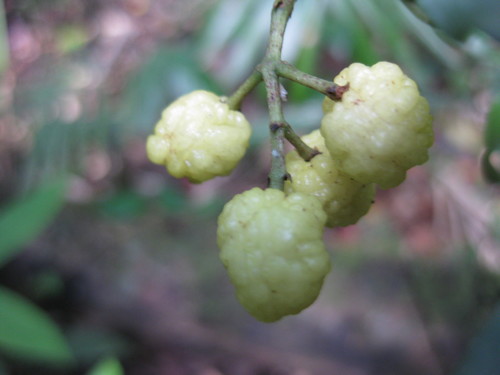
Zanthoxylum lemairei
(De Wild.) Waterm.

gbif · cc-by
Meise Botanic Garden
Meise Botanic Garden

gbif · cc-by
Meise Botanic Garden
Meise Botanic Garden

gbif · cc-by
Meise Botanic Garden
Meise Botanic Garden
What to Eat
Edible parts: Fruit - flavouring, Spice, Seeds - oil
The fruit is used as a flavouring and spice. Oil is extracted from the seeds for culinary use.
Where to Find It
It is a tropical plant. It grows in closed forest in West Africa.
Africa, Angola, Cameroon, Central Africa, Central African Republic, CAR, Congo DR, East Africa, Ghana, Mozambique, Niger, Nigeria, Senegal, South Africa, Southern Africa, Uganda, West Africa,
Countries: Angola, Burkina Faso, Burundi, Benin, Botswana, Congo (DRC), Central African Republic, Congo (Republic), Cote d'Ivoire, Cameroon, Cape Verde, Djibouti, Algeria, Egypt, Eritrea, Ethiopia, Gabon, Ghana, Gambia, Guinea, Equatorial Guinea, Guinea-Bissau, Kenya, Comoros, Liberia, Lesotho, Libya, Morocco, Madagascar, Mali, Mauritania, Mauritius, Malawi, Mozambique, Namibia, Niger, Nigeria, Rwanda, Seychelles, Sudan, Sierra Leone, Senegal, Somalia, South Sudan, Sao Tome & Principe, Eswatini, Chad, Togo, Tunisia, Tanzania, Uganda, South Africa, Zambia, Zimbabwe
How to Identify
A tree. It grows 25 m high. The trunk is 1.8 m around. There are spines near the base.
Names & Synonyms
Bolongolo, Ukhankhan
Fagara gracilifolia Mildbr. ex Engl.Fagara lemairei De Wild.Fagara parvifoliola A. Chev. ex KeayZanthoxylum parvifoliolum (A. Chev. ex Keay) Hawthorne
References (4)
- Burkill, H. M., 1985, The useful plants of west tropical Africa, Vol. 4. Kew.
- Martin, F. W., et al, 1987, Perennial Edible Fruits of the Tropics. USDA Handbook 642 p 76
- Perennial Edible Fruit (As Fagara lemairei)
- World Checklist of Useful Plant Species 2020. Royal Botanic Gardens, Kew