Calystegia sepium
(L.) R. Br.
White Bindweed, Large Bindweed, Hedge Bindweed

(c) Heather Pickard, some rights reserved (CC BY-NC), uploaded by Heather Pickard
(c) Masha, some rights reserved (CC BY-NC), uploaded by Masha

(c) Suzanne Labbé, some rights reserved (CC BY-NC), uploaded by Suzanne Labbé
What to Eat
Edible parts: Leaves, Root, Stalks, Flowers, Caution
Edible Parts: Leaves Root Shoots Edible Uses: Stalks and root - cooked. Washed and steamed. A pleasant sweet taste. Rich in starch and sugars, it is very nutritious. It should not be eaten regularly, however, due to its possible purgative effect. Young shoots - cooked. Some caution is advised since they are possibly purgative.
Known Hazards
Where to Find It
It is a temperate plant. It grows in shady gullies and along streams. It grows in coastal salt-marshes and reed swamps. Tasmania Herbarium. In Yunnan.
Argentina, Asia, Australia*, Britain, Central Asia, Chile, China, Easter Island, Europe, France, Greece, India, Italy, Japan, Korea, Luxembourg, Mediterranean, Mongolia, Portugal, Russia, Sicily, Slovenia, South America, Spain, Tajikistan, Tasmania*, Turkey, Türkiye,
How to Identify
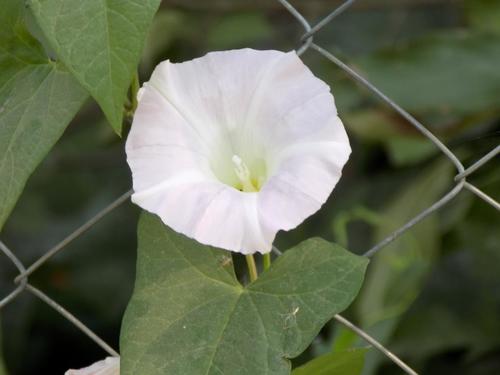
A slender climber. It keeps growing from year to year. It grows 1-4 m high. It has both underground stems or rhizomes and runners or stolons. It climbs over supports. The stems are smooth and twining. They twine in an anticlockwise direction. The leaves are 5-15 cm long and 2-4 cm wide. They are oval or triangle shaped or like an arrowhead. They are light green. The leaf stalks are almost free of hairs. The flowers are 5-8 cm long and about 4 cm across. They are white or pink and funnel shaped. They occur singly in the axils of leaves. They are on long stalks. The flowers open during the day and close at night. The fruit is a capsule about 1 cm across.
How to Grow
It can be grown by seed or stem cuttings.
Propagation: Seed - sow spring in a cold frame in a free draining compost and only just cover. The seed usually germinates in 1 - 3 months at 15°c. When they are large enough to handle, prick the seedlings out into individual pots and grow them on in a cold frame for at least their first winter. Plant them out into their permanent positions in late spring or early summer, after the last expected frosts. Division in early spring whilst dormant.
Medicinal Uses
Cholagogue Demulcent Diuretic Febrifuge Poultice Purgative The root is demulcent, diuretic, febrifuge, poultice and strongly purgative. Use of the root is believed to increase the flow of bile.
Other Uses
String The stems are very flexible and can be used as an emergency string for tying. It is fairly strong but not very long-lasting. Special Uses
Wikipedia
Source ↗Calystegia sepium (Rutland beauty, bugle vine, heavenly trumpets, bellbind, granny-pop-out-of-bed and many others) is a species of flowering plant in the family Convolvulaceae. It has a subcosmopolitan distribution throughout temperate regions of the North and South hemispheres.
Other Information
It is cultivated.
Notes
There are 25 Calystegia species.
Names & Synonyms
Bellvine, Greater Bindweed, Navadni plotni slak
References (25)
- Arora, R. K., 2014, Diversity in Underutilized Plant Species - An Asia-Pacific Perspective. Bioversity International. p 24
- Bircher, A. G. & Bircher, W. H., 2000, Encyclopedia of Fruit Trees and Edible Flowering Plants in Egypt and the Subtropics. AUC Press. p 75
- Blamey, M and Grey-Wilson, C., 2005, Wild flowers of the Mediterranean. A & C Black London. p 183
- Bodkin, F., 1991, Encyclopedia Botanica. Cornstalk publishing, p 205
- Crowe, A., 1997, A Field Guide to the Native Edible Plants of New Zealand. Penguin. p 69
- Curtis, W.M., 1993, The Student's Flora of Tasmania. Part 3 St David's Park Publishing, Tasmania, p 498
- Dashorst, G.R.M., and Jessop, J.P., 1998, Plants of the Adelaide Plains & Hills. Botanic Gardens of Adelaide and State Herbarium. p 122
- Elliot, W.R., & Jones, D.L., 1982, Encyclopedia of Australian Plants suitable for cultivation. Vol 2. Lothian. p 444
- Fang Rhui-cheng; George Staples, CONVOLVULACEAE Flora of China
- Hedrick, U.P., 1919, (Ed.), Sturtevant's edible plants of the world. p 145
- Heywood, V.H., Brummitt, R.K., Culham, A., and Seberg, O. 2007, Flowering Plant Families of the World. Royal Botanical Gardens, Kew. p 109
- Kermath, B. M., et al, 2014, Food Plants in the Americas: A survey of the domesticated, cultivated and wild plants used for Human food in North, Central and South America and the Caribbean. On line draft. p 168
- Lamp, C & Collet F., 1989, Field Guide to Weeds in Australia. Inkata Press. p 49
- Lazarides, M. & Hince, B., 1993, Handbook of Economic Plants of Australia, CSIRO. p 45
- Licata, M., et al, 2016, A survey of wild plant species for food use in Sicily (Italy) – results of a 3-year study in four Regional Parks. Journal of Ethnobiology and Ethnomedicine 12:12
- Lim, T. K., 2015, Edible Medicinal and Non Medicinal Plants. Volume 9, Modified Stems, Roots, Bulbs. Springer p 21
- Liu, Yi-tao, & Long, Chun-Lin, 2002, Studies on Edible Flowers Consumed by Ethnic Groups in Yunnan. Acta Botanica Yunnanica. 24(1):41-56
- Paczkowska, G. & Chapman, A.R., 2000, The Western Australian Flora. A Descriptive Catalogue. Western Australian Herbarium. p 216
- Plants for a Future database, The Field, Penpol, Lostwithiel, Cornwall, PL22 0NG, UK. http://www.scs.leeds.ac.uk/pfaf/
- Prodr. 483. 1810
- READ,
- Romanowski, N., 2007, Edible Water Gardens. Hyland House. p 105
- Tasmanian Herbarium Vascular Plants list p 22
- UPHOF,
- Zizka, G., 1991, Flowering Plants of Easter Island. Palmarum Hortus Francofurtensis


