Canavalia papuana
Merr. & Perry
Wild Jack bean
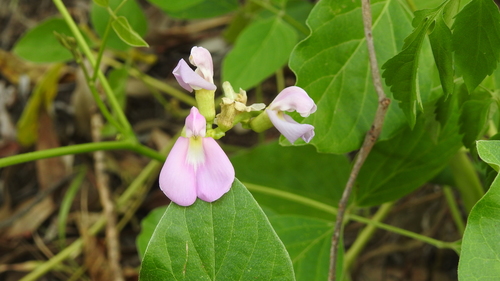
(c) Bruce McLennan, some rights reserved (CC BY-NC), uploaded by Bruce McLennan

(c) Russell Cumming, some rights reserved (CC BY-NC)

(c) Russell Cumming, some rights reserved (CC BY-NC)
What to Eat
Edible parts: Seeds - coffee
The seeds have been roasted and used to make coffee.
Where to Find It
A tropical plant. It grows in warm, moist coastal districts. It is very cold sensitive. It needs well drained soil in a sunny position. It grows from 5 to 1250 m altitude in Papua New Guinea. In tropical Australia it grows from sea level to 630 m altitude.
Australia*, East Timor, Pacific, Papua New Guinea, PNG, SE Asia, Timor-Leste,
How to Identify
A climbing bean up to 1-4 m tall. The stems are thin and wiry. They do not have hairs except at the nodes. The leaves have 3 leaflets. The leaf stalks are 4-10 cm long. They have a channel on the top surface. The leaflets are 10-13 cm long by 5-8 cm wide. The leaflets are thin, but oval and pointed at the top. The flowers are about 3 cm long. They are purple with a curved blunt keel. The flowers are in clusters of 10-20 flowers on flower stalks 10-14 cm long. The pods are 6-8 cm long by 1.5-2 cm wide. They are oblong and have a keel. The seeds are dark brown and oblong. They are 1.3 cm long by 8 mm wide. The seed scar is about 1 cm long.
How to Grow
Plants are grown from seed.
Notes
There are about 50 Canavalia species.
References (8)
- Cooper, W. and Cooper, W., 2004, Fruits of the Australian Tropical Rainforest. Nokomis Editions, Victoria, Australia. p 203
- Cowie, I, 2006, A Survey of Flora and vegetation of the proposed Jaco-Tutuala-Lore National Park. Timor-Lests (East Timor) www.territorystories.nt/gov.au p 47
- Elliot, W.R., & Jones, D.L., 1982, Encyclopedia of Australian Plants suitable for cultivation. Vol 2. Lothian. p 456
- Jackes, B.R., 2001, Plants of the Tropics. Rainforest to Heath. An Identification Guide. James Cook University. p 54
- Low, T., 1992, Bush Tucker. Australia’s Wild Food Harvest. Angus & Robertson. p 27
- Melzer, R. & Plumb, J., 2011, Plants of Capricornia. Belgamba, Rockhampton. p 367
- Paczkowska, G . & Chapman, A.R., 2000, The Western Australian Flora. A Descriptive Catalogue. Western Australian Herbarium. p 419
- Townsend, K., 1994, Across the Top. Gardening with Australian Plants in the tropics. Society for Growing Australian Plants, Townsville Branch Inc. p 119




