Canna glauca
L.
Mexican canna
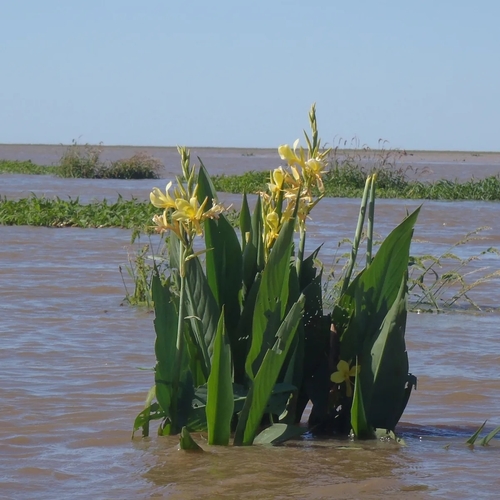
(c) gretelsarettoneffen, some rights reserved (CC BY-NC)

(c) Wendy McCrady, some rights reserved (CC BY), uploaded by Wendy McCrady
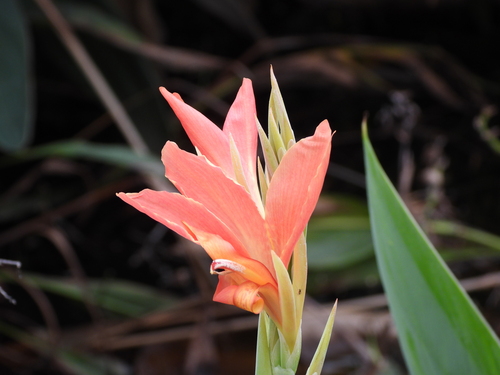
(c) D.A. Ostiarius, some rights reserved (CC BY-NC), uploaded by D.A. Ostiarius
What to Eat
Edible parts: Fruit, Seed, Root, Rhizome
The root is eaten cooked. Starch can be extracted from it and used as an arrowroot by rasping the root to a pulp, then washing and straining to remove the fibres. Very young tubers can also be eaten cooked — they are sweet but fibrous. One report suggests the fruit may be edible but provides no further details; the fruit is a dry capsule.
Where to Find It
A subtropical plant. They grow best in sunny positions. They need rich soils and can be in water 30 cm deep. It grows in seasonally wet locations. In Brazil it grows below 1,000 m above sea level. It suits hardiness zones 9-11.
Antilles, Argentina, Asia, Australia, Brazil, Central America*, Haiti, Hawaii, Indonesia, Mexico, North America, Pacific, Paraguay, Peru, SE Asia, South America, Uruguay, USA, West Indies,
How to Identify
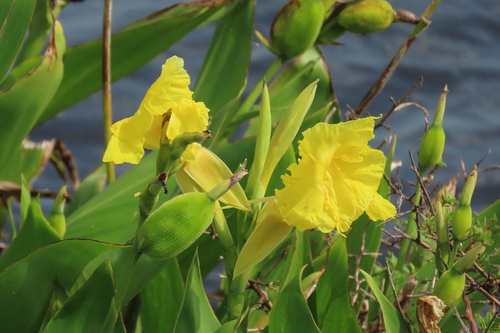
A herb. It has long slender stems. These grow 1.2-2 m high. It has creeping, slender underground stems or rhizomes. It spreads 30-90 cm wide. The leaves are greyish and sword shaped. They are pointed. They are 45-70 cm long and white along the edges. They are 2-14 cm wide. They clasp the stem at the base. The flowers are yellow. They are in clusters of about 10. The flowers are 8-10 cm long. The fruit are 2-5 cm long and have warty projections over them. They contain many small seeds. They are brown with black marks.
How to Grow
Requires a deep rich well-drained soil in a sunny position. The plant has large leaves and dislikes windy conditions since this can tear the leaves to shreds. This species is not very hardy in Britain, it succeeds outdoors in S. Devon, but even there it should be given a good protective mulch over the winter. Plants can be grown as summer bedding in many parts of the country, the tubers can be dug up in the autumn after being lightly frosted. They can be stored over winter in a cool but frost-free place in moist soil or leaves. Slugs love the young growth in spring and can cause serious damage to plants.
Propagation: Pre-soak seeds for 24 hours in warm water, then sow in February or March in a warm greenhouse at 20°C, planting 2–5cm deep in individual pots. Scarifying the seed can speed germination, particularly if the seed has not swollen after soaking. Germination usually occurs in 3–9 weeks. Grow plants on in a greenhouse for at least their first winter, then plant out in late spring or early summer after the last expected frosts. The root clump can be divided as the plant comes into growth in spring; each portion must have at least one growing point. Pot up divisions and grow on in the greenhouse until well established before planting out in summer. Root cuttings are also an option.
Medicinal Uses
None known
Other Uses
None known
Wikipedia
Source ↗Canna glauca is a species of the Canna genus, a member of the family Cannaceae. It is commonly known as water canna or Louisiana canna. It is native to the wetlands of tropical America and was introduced to England in 1730. It is also reportedly naturalized in Sri Lanka, Thailand, Vietnam, Java and the Philippines.
Production
Rhizomes have a better taste when harvested in autumn or winter.
Notes
There are about 50 Canna species. They grow in the tropics and subtropics.
Names & Synonyms
Achira, Andurinha, Bacao, Bananinha-do-brejo, Caete, Cana-do-brejo, Imbiri, Kana Louisiana, Louisiana cannam Makya, Maraca amarilla, Water canna
References (23)
- Bircher, A. G. & Bircher, W. H., 2000, Encyclopedia of Fruit Trees and Edible Flowering Plants in Egypt and the Subtropics. AUC Press. p 80
- Bortolotto, I. M., et al, 2018, Lista preliminar das plantas alimenticias nativas de Mato Grosso do Sul, Brasil. Iheringia, Serie Botanica, Porto Alegre, 73 (supl.):101-116
- Cundall, P., (ed.), 2004, Gardening Australia: flora: the gardener's bible. ABC Books. p 324
- Hedrick, U.P., 1919, (Ed.), Sturtevant's edible plants of the world. p 150
- Heywood, V.H., Brummitt, R.K., Culham, A., and Seberg, O., 2007, Flowering Plant Families of the World. Royal Botanical Gardens, Kew. p 357
- Hibbert, M., 2002, The Aussie Plant Finder 2002, Florilegium. p 59
- INFOODSUpdatedFGU-list.xls
- Kermath, B. M., et al, 2014, Food Plants in the Americas: A survey of the domesticated, cultivated and wild plants used for Human food in North, Central and South America and the Caribbean. On line draft. p 174
- Kinupp, V. F., 2007, Plantas alimenticias nao-convencionais da regiao metropolitana de Porto Alegre, RS, Brazil p 72
- Kinupp, V. F. & Bergman, I., 2008, Protein and minerals of native species, potential vegetables and fruits. Cienc.Tecnol. Aliment. Vol. 28 No. 4 Campinas Oct/Dec.
- Oliviera V. B., et al, 2012, Native foods from Brazilian biodiversity as a source of bioactive compounds. Food Research International 48 (2012) 170-179
- Plants for a Future database, The Field, Penpol, Lostwithiel, Cornwall, PL22 0NG, UK. http://www.scs.leeds.ac.uk/pfaf/
- Polini, G., et al, Useful and edible plants of Paraguay Region of Chaco. p 50
- Romanowski, N., 2007, Edible Water Gardens. Hyland House. p 51
- Ryan, S., 2008, Dicksonia. Rare Plants Manual. Hyland House. p 97
- Scarpa, G. F., 2009, Wild food plants used by the indigenous peoples of South American Gran Chaco: A general synopsis and intercultural comparison. Journal of Applied Botany and Food Quality 83:90-101
- Schmedia-Hirschmann, G., 1994, Plants resources Used by the Ayoreo of the Paraguayan Chaco. Economic Botany Vol. 48. No. 3. pp. 252-258
- Slocum, P.D. & Robinson, P., 1999, Water Gardening. Water Lilies and Lotuses. Timber Press. p 91
- Sp. pl. 1:1. 1753
- Staples, G.W. and Herbst, D.R., 2005, A tropical Garden Flora. Bishop Museum Press, Honolulu, Hawaii. p 646
- Sukarya, D. G., (Ed.) 2013, 3,500 Plant Species of the Botanic Gardens of Indonesia. LIPI p 1086
- Wiersema, J. H. & Leon, B., 2013, World Economic Plants. A Standard Reference CRC Press. 2nd Ed. p 139
- World Checklist of Useful Plant Species 2020. Royal Botanic Gardens, Kew