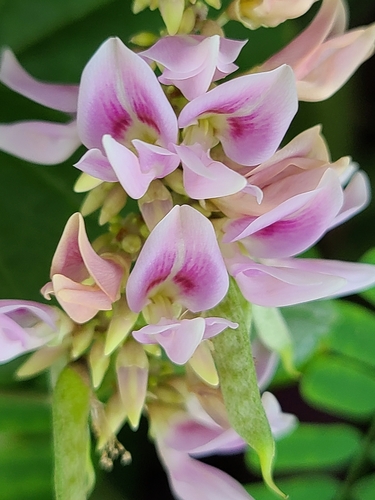
Acacia acuminata
Benth.
Raspberry jam wattle

(c) Arthur Chapman, some rights reserved (CC BY-NC-SA)
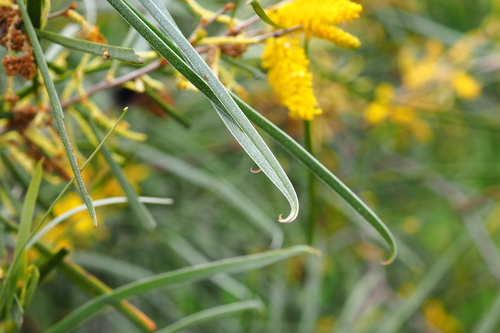
(c) Holly Price, some rights reserved (CC BY-NC), uploaded by Holly Price
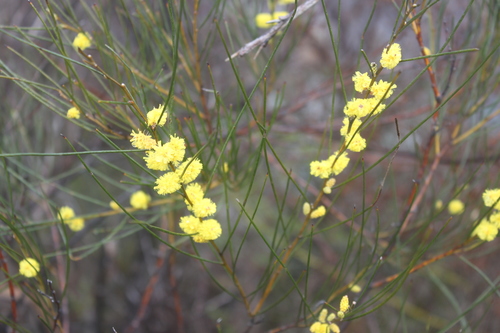
(c) Erwin Sieben, some rights reserved (CC BY-NC), uploaded by Erwin Sieben
What to Eat
Edible parts: Gum, Seeds
The edible gum can be eaten raw, mixed with water and stored like honey, or used as a sweetener. Ripe seeds are cooked and eaten.
Where to Find It
A temperate plant. It prefers light well drained soils. It does best in sunny positions. It can withstand drought and frost. It grows naturally in semi-arid woodlands in Western Australia. It can grow in arid places. It can grow on limestone soils. They can be alkaline. It grows in areas with an annual rainfall between 200-1,100 mm. It grows below 375 m above sea level.
Africa, Australia*, Iran, Israel, Mediterranean, Middle East, South Africa,
How to Identify
A shrub or small tree. It grows 5 m tall. There are prickles along the stem. The leaves are twice divided and there are 8-18 pairs of pinnae. There are up to 50 pairs of pinnules on each pinnae. The flowers are yellow. They are in large clusters at the ends of branches. The pods are flattened.
How to Grow
It is grown from seed. Seed needs to be treated first to enable it to grow. Normally this is by putting the seeds in very hot water and letting the water cool down overnight then planting the seeds immediately.
Wikipedia
Source ↗Acacia acuminata, commonly known as raspberry jam, jam, jam wattle, jamwood, jam tree, or raspberry wattle, is a species of flowering plant in the family Fabaceae and is endemic to the south-west of Western Australia. It is a tree with linear to narrowly elliptic phyllodes, spikes of golden-yellow flowers and papery to leathery pods.
Production
Trees grow quickly. They flower from July to October following rains.
Notes
There are about 1,350 Acacia species. Over 1,000 occur in Australia. Also as Mimosaceae.
Names & Synonyms
Raspberry Jam Wood
References (13)
- Bodkin, F., 1991, Encyclopedia Botanica. Cornstalk publishing, p 7
- Bindon, P., 1996, Useful Bush Plants. Western Australian Museum. p 5
- Cherikoff V. & Isaacs, J., The Bush Food Handbook. How to gather, grow, process and cook Australian Wild Foods. Ti Tree Press, Australia p 188
- Elliot, W.R., & Jones, D.L., 1982, Encyclopedia of Australian Plants suitable for cultivation. Vol 2. Lothian. p 13
- Hall, N. et al, 1972, The Use of Trees and Shrubs in the Dry Country of Australia, AGPS, Canberra. p 342
- Lazarides, M. & Hince, B., 1993, Handbook of Economic Plants of Australia, CSIRO. p 1
- London J. Bot. 1:373. 1842
- Lord, E.E., & Willis, J.H., 1999, Shrubs and Trees for Australian gardens. Lothian. p 36
- Molyneux, B. and Forrester, S., 1997, The Austraflora A-Z of Australian Plants. Reed. p 31
- Paczkowska, G. & Chapman, A.R., 2000, The Western Australian Flora. A Descriptive Catalogue. Western Australian Herbarium. p 296
- Rolsh, 1994, Wildflowers of the Western State, Rolsh Productions Albany WA. p 30
- Royal Botanic Gardens, Kew (1999). Survey of Economic Plants for Arid and Semi-Arid Lands (SEPASAL) database. Published on the Internet; http://www.rbgkew.org.uk/ceb/sepasal/internet [Accessed 26th April 2011]
- World Checklist of Useful Plant Species 2020. Royal Botanic Gardens, Kew