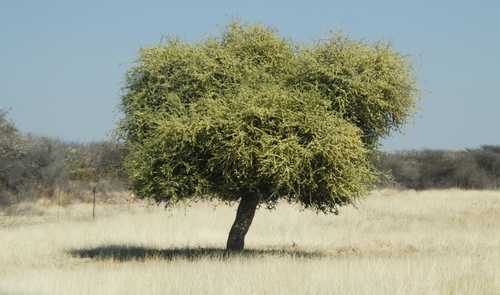
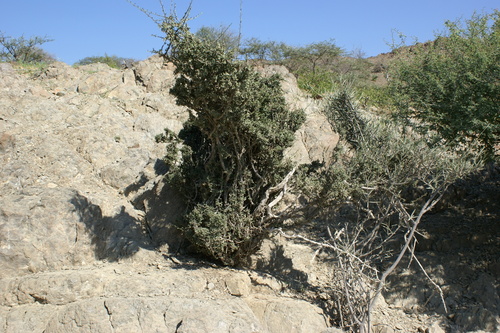
Capparis lucida
(DC.) R. Br. ex Benth.
Coastal caper, Native Caper, Wood Caper
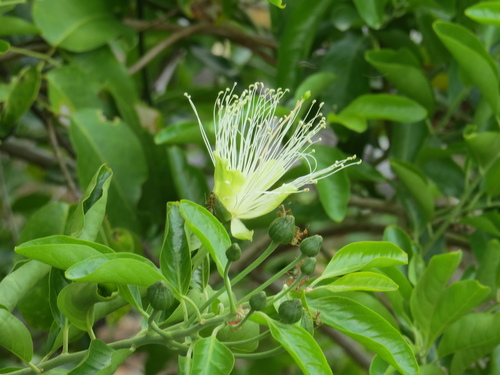
(c) coenobita, some rights reserved (CC BY), uploaded by coenobita

(c) ryanthughes, some rights reserved (CC BY-NC)
What to Eat
Edible parts: Fruit, Buds
The fruit flesh is edible, and the flower buds can also be eaten.
Where to Find It
It is a tropical plant. It grows naturally in lowland rainforest in Queensland, Australia. It needs well-drained soil and full sun. It grows at low elevations close to the beach.
Asia, Australia*, Indonesia, Malesia, SE Asia, Timor-Leste, Torres Strait,
How to Identify
A vine, shrub or tree up to 12 m high. The leaves are simple and 3-10 cm long. They can have a few hairs along the midrib on the upper side. The leaves are shiny. The flowers are white or pale yellow. They are 3-4 cm across. They occur on stalks 2-5 cm long in clusters at the ends of branches. The fruit are 17-50 mm across. They can occur singly or in bunches. They are red, purple or black. There are several seeds. These are 6-8 mm long. The flesh is edible.
How to Grow
Plants can be grown from seed.
Wikipedia
Source ↗Capparis lucida, commonly referred to as the coast caper, is a versatile plant that often grows as a small tree or a shrub, usually reaching heights of 3 to 4 meters. While it may sometimes climb, it typically produces flowers and fruits as a shrub. The leaves are glossy and range from 3 to 10 cm long and 2 to 5 cm wide, with a noticeable central vein and smaller veins forming loops near the edges. Both the petioles (the stalk attaching the leaf to the stem) and twigs are covered in fine, soft hairs. The flowers of the coast caper are quite distinct, featuring sepals (the outer parts of the flower) that are 9 to 13 mm long. The outer sepals are fused into a cap-like structure that splits open unevenly, while the inner sepals remain separate. The petals are white or pale, about 15 to 20 mm long, and there are a striking number of stamens (the pollen-producing parts) — anywhere from 50 to 85. The long stalk that supports the ovary, called the gynophore, can be 25 to 65 mm long and is hairy at the base. The fruit is a round, smooth-skinned berry, about 2.5 to 5 cm in diameter, containing many seeds. Each seed is around 6 mm long and has a unique spiraled embryo with folded cotyledons (the first leaves of the seedling). Although this plant can host caper whites (Belenois java teutonia) and chalk whites (Elodina parthia) successfully, it is not their preferred host plant. Caper gulls (Cepora perimale scyllara) have been recorded to lay on this plant.
Notes
There are about 250 Capparis species. There are about 50 Capparis species in tropical America.
Names & Synonyms
Kadal darng, Pohan kaper pantai
References (12)
- Cherikoff V. & Isaacs, J., The Bush Food Handbook. How to gather, grow, process and cook Australian Wild Foods. Ti Tree Press, Australia p 198
- Cooper W & Cooper W T, 1994, Fruits of the Rain Forest. RD Press p 64
- Cooper, W. and Cooper, W., 2004, Fruits of the Australian Tropical Rainforest. Nokomis Editions, Victoria, Australia. p 109
- Elliot, W.R., & Jones, D.L., 1982, Encyclopedia of Australian Plants suitable for cultivation. Vol 2. Lothian. p 459
- Flora of Australia, Volume 8, Lecythidales to Batales, Australian Government Publishing Service, Canberra (1982) p 217
- Habitat Management Profile – Saibai Island Appendix C p 114
- Hardwick, G., 2001, Economically Useful Plants for Northern Australia: Master Species List. Crusader eBooks.
- Jackes, B.R., 2001, Plants of the Tropics. Rainforest to Heath. An Identification Guide. James Cook University. p 46
- Paczkowska, G. & Chapman, A.R., 2000, The Western Australian Flora. A Descriptive Catalogue. Western Australian Herbarium. p 194
- Scarth-Johnson, V., 2000, National Treasures. Flowering Plants of Cooktown and Northern Australia. Vera Scarth-Johnson Gallery Association. Cooktown, Australia. p 77
- Sukarya, D. G., (Ed.) 2013, 3,500 Plant Species of the Botanic Gardens of Indonesia. LIPI p 180
- Townsend, K., 1994, Across the Top. Gardening with Australian Plants in the tropics. Society for Growing Australian Plants, Townsville Branch Inc. p 121