Capparis mitchellii
(Lindley ex F. Muell.) Lindl.
Wild desert orange, Wild caper

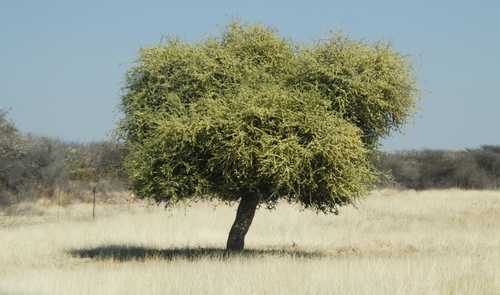
(c) Gavin Goodyear, some rights reserved (CC BY-NC), uploaded by Gavin Goodyear

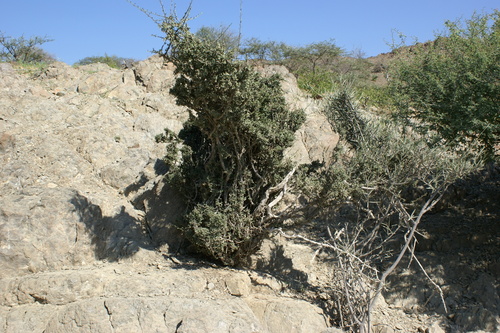
(c) Tony Rodd, some rights reserved (CC BY-NC-SA)
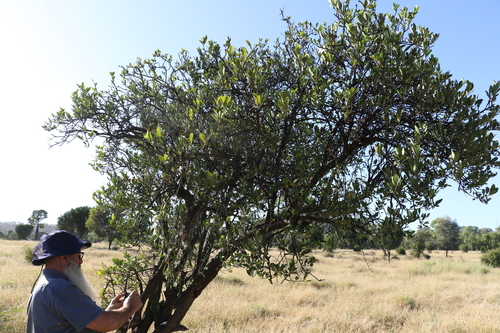
(c) Greg Tasney, some rights reserved (CC BY-SA), uploaded by Greg Tasney
What to Eat
Edible parts: Fruit
Edible fruit - raw or cooked. Not very palatable. When fully ripe, the pulpy flesh has an excellent, bittersweet flavour. The aromatic fruit is well regarded by the local Aborigines. The purple to black, ovoid or ellipsoid fruit is about 75mm x 75mm.
Where to Find It
It grows in tropical and subtropical places. It grows in inland areas in Australia. They can grow on most soils. They will not tolerate poor drainage. It can grow in arid places. It suits hardiness zones 9-12.
Australia*,
How to Identify
A tall shrub or small spreading tree. It grows 3-10 m high. The branches have spines. The leaves are oval and rigid and leathery. They are 2-6 cm long by 1-3 cm wide. The flowers are white or cream. They are about 5 cm across. They are on stalks 3-4 cm long. They occur singly in the axils of leaves or in small clumps near the ends of branches. The fruit are berries. They are 4-7 cm across. They are round and purple or dull orange. The fruit are edible.
Nutrition Score: 57/100
| Part | Moisture | kJ | kcal | Protein | Vit A | Vit C | Iron | Zinc |
|---|---|---|---|---|---|---|---|---|
| Fruit | 63.1 | 500 | 120 | 5.8 | — | 74 | 0.7 | 0.1 |
How to Grow
Plants can be grown from seed or cuttings.
Propagation: Seed - best sown as soon as it is ripe. Cuttings of half-ripe wood.
Wikipedia
Source ↗The wild orange is an Australian native plant found in dry inland areas of Australia. Its scientific name is Capparis mitchellii. It is not related to oranges, nor to the Osage-orange which is known as "wild orange" in North America, but to capers. Used by Aboriginal Australians as bush tucker long before European settlement in Australia, the fruit is a good source of vitamin C and may be enjoyed raw or in sweet and savoury dishes.
Production
Fruit need to be very ripe.
Notes
There are about 250 Capparis species. There are about 50 Capparis species in tropical America.
Names & Synonyms
Atakwey, Atwakey, Bumbil, Bumble tree, Bambul, Kajawarri, Native Orange, Tree Caper
References (44)
- Bindon, P., 1996, Useful Bush Plants. Western Australian Museum. p 70
- Bircher, A. G. & Bircher, W. H., 2000, Encyclopedia of Fruit Trees and Edible Flowering Plants in Egypt and the Subtropics. AUC Press. p 81
- Bodkin, F., 1991, Encyclopedia Botanica. Cornstalk publishing, p 211
- Bonney, N., 1997, Economic Native Trees and Shrubs for South Australia. Greening Australia (SA) inc. Campbelltown SA 5074 p 55
- Bonney, N., 2012, Edible Wild Native Plants for Southern Australia. p 110
- Boomsma, C.D., 1972, Native Tree of South Australia. Woods & Forests Department South Australia, Bulletin No.19. p 64
- Brown, D., 2002, The Royal Horticultural Society encyclopedia of Herbs and their uses. DK Books. p 153
- Cancilla, D., 2018, Ethnobotanical and Ethnozoological Values Desktop Assessment - Eliwana Project. p 10
- Cherikoff V. & Isaacs, J., The Bush Food Handbook. How to gather, grow, process and cook Australian Wild Foods. Ti Tree Press, Australia p 189
- Cronin, L., 1989, The Concise Australian Flora. Reed. p 135
- Cundall, P., (ed.), 2004, Gardening Australia: flora: the gardener's bible. ABC Books. p 326
- Doran, J.C., & Turnbull, J.W. (Eds), 1997, Australian Trees and Shrubs: species for land rehabilitation and farm plantings in the tropics. ACIAR Monograph No 24. p 257
- Eddie, C., 2007, Field Guide to Trees and Shrubs of Eastern Queensland Oil and Gas Fields. Santos p 112
- Elliot, W.R., & Jones, D.L., 1982, Encyclopedia of Australian Plants suitable for cultivation. Vol 2. Lothian. p 459
- Etherington, K., & Imwold, D., (Eds), 2001, Botanica's Trees & Shrubs. The illustrated A-Z of over 8500 trees and shrubs. Random House, Australia. p 180
- Facciola, S., 1998, Cornucopia 2: a Source Book of Edible Plants. Kampong Publications, p 71
- Flora of Australia, Volume 8, Lecythidales to Batales, Australian Government Publishing Service, Canberra (1982) p 217
- Green, J., (Ed.), 2003, Anmatyerr Plant Stories. AID Press. p 2
- Hall, N. et al, 1972, The Use of Trees and Shrubs in the Dry Country of Australia, AGPS, Canberra. p 357
- Hardwick, G., 2001, Economically Useful Plants for Northern Australia: Master Species List. Crusader eBooks.
- Hiddins, L., 1999, Explore Wild Australia with the Bush Tucker Man. Penguin Books/ABC Books. p 168
- Holliday, I., 1989, A Field Guide to Australian Trees. Hamlyn. p 100
- Hunter, J. T. et al, Budjiti traditional use of plants on Naree Station. p 3
- Hunter, J., 2012, Vegetation and Floristics of Gilwarny and Wingadee Nature Reserves. A Report to the New South Wales National Parks and Wildlife Service p 112
- Hunter, J.T., 2017, Is there a relationship between contemporary high Aboriginal plant resource locations and mapped vegetation communities? Cunninghamia 17:27-34. The Royal Botanic Garden Sydney. ISSN 2200 - 405X
- INFOODS:FAO/INFOODS Databases
- Latz, P.K., 1996, Bushfires and Bushtucker: Aboriginal plant use in Central Australia. IAD Press Alice Springs p 139
- Latz, P & Wightman, G., 1995, Desert Bush Tucker Identikit. Common Native Food Plants of Central Australia. Parks & Wild Commission Northern territory. p 14
- Lazarides, M. & Hince, B., 1993, Handbook of Economic Plants of Australia, CSIRO. p 47
- Lord, E.E., & Willis, J.H., 1999, Shrubs and Trees for Australian gardens. Lothian. p 13
- Low, T., 1991, Wild Food Plants of Australia. Australian Nature FieldGuide, Angus & Robertson. p 173
- Low, T., 1992, Bush Tucker. Australia’s Wild Food Harvest. Angus & Robertson. p 69
- McKerney, M. & White, H., 2011, Bush Tucker, Boomerangs & Bandages. Border River-Gwyder Catchment Management Authority p 95
- T. Mitch., Three exped. Australia 1:311. 1838
- Miers, G., 2004, Cultivation and sustainable wild harvest of Bushfoods by Aboriginal Communities in Central Australia. RIRDC report W03/124 p 19
- Morley, B.D., & Toelken, H.R., (Eds), 1983, Flowering Plants in Australia. Rigby. p 102
- Paczkowska, G. & Chapman, A.R., 2000, The Western Australian Flora. A Descriptive Catalogue. Western Australian Herbarium. p 194
- Robins, J., 1996, Wild Lime. Cooking from the Bush food garden. Allen & Unwin p 25
- Spearrit, G., 2016, Plants of Irongate Conservation Park. Amaroo Environmental Education Centre.
- Steenbeeke, Greg as part of the Plants Directory project. List of plant species from northern NSW that may be used as food plants p 15
- Townsend, K., 1994, Across the Top. Gardening with Australian Plants in the tropics. Society for Growing Australian Plants, Townsville Branch Inc. p 121
- Urban, A., 1990, Wildflowers of Inland Australia. Portside editions. p 58
- Wightman, Glenn et al. 1994, Gurindji Ethnobotany: Aboriginal Plant Use from Daguragu Northern Australia. Northern Territory Botanical Bulletin No 18. Parks and Wildlife Commission of the Northern Territory. p. 14.
- World Checklist of Useful Plant Species 2020. Royal Botanic Gardens, Kew