Searsia burchellii
Sond. ex Engl.
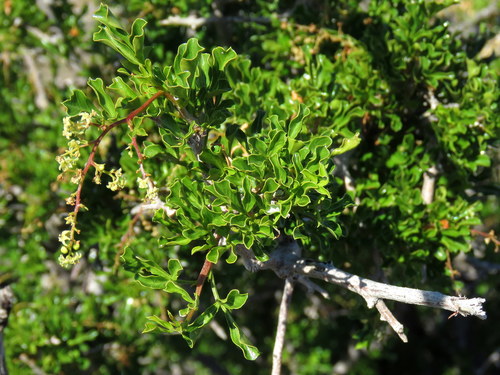
(c) Gigi Laidler, some rights reserved (CC BY-NC), uploaded by Gigi Laidler

(c) Tony Rebelo, some rights reserved (CC BY-SA), uploaded by Tony Rebelo
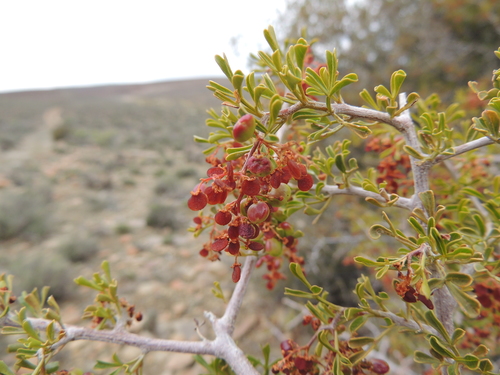
(c) Marinda, some rights reserved (CC BY-NC), uploaded by Marinda
What to Eat
Edible parts: Fruit
The fruit are cleaned, husks removed, and combined with milk then left to stand for 4 hours to make a porridge-like food that is eaten in large amounts. The fruit can also be dried and eaten.
Where to Find It
It is a subtropical plant. It grows in places with a marked dry season. It can tolerate frost. It suits hot arid places. In South Africa it grows from 60-2,000 m above sea level. It is in semi-desert. It can tolerate drought. It can grow in arid places.
Africa, Lesotho, Namibia, South Africa, Southern Africa,
How to Identify
An evergreen bush. It grows 2.5-5 m tall. It keeps growing from year to year. There can be thorns on the stems. The bark is grey-brown. The branches are somewhat square. The leaves are crowded on spur like branches. The leaves have 3 leaflets. They are dark green and leathery. The flowers are small and star like. They are green to yellow. The fruit are flattened and 5 mm across. They are shiny green and turn red then brown as they ripen.
How to Grow
It can be cut back and will regrow.
Names & Synonyms
Garra, Kunibos, Taaibos, Tgarra
References (6)
- Fox, F. W. & Young, M. E. N., 1982, Food from the Veld. Delta Books. p 77 (As Rhus undulata var. tricrenata)
- Moffett, R. O., 2007, Name changes in the Old World Rhus and recognition of Searsia (Anacardiaceae) Bothalia 37,2: 165-175 (2007)
- Royal Botanic Gardens, Kew (1999). Survey of Economic Plants for Arid and Semi-Arid Lands (SEPASAL) database. Published on the Internet; http://www.rbgkew.org.uk/ceb/sepasal/internet [Accessed 28th March 2011] (As Rhus burchellii)
- Ruiters-Welcome, A. K., 2019, Food plants of southern Africa. Ph.D. thesis. Univ. of Johannesburg p 14
- Welcome, A. K. & Van Wyk, B.-E., 2019, An inventory and analysis of the food plants of southern Africa. South African Journal of Botany 122 (2019) 136–179
- World Checklist of Useful Plant Species 2020. Royal Botanic Gardens, Kew