Ectadium virgatum
E. Mey.
Slender Ectadium

(c) pietermier, some rights reserved (CC BY-NC)

(c) pietermier, some rights reserved (CC BY-NC)
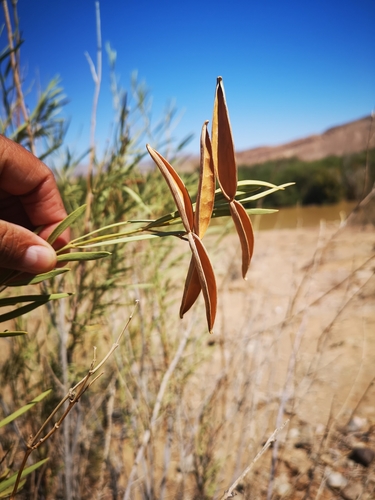
(c) Ismail Ebrahim, some rights reserved (CC BY-NC), uploaded by Ismail Ebrahim
What to Eat
Edible parts: Fruit
The outermost layer of the fruit is roasted and ground for use as a vegetable.
Where to Find It
It is a subtropical plant. It grows in hot, arid areas where there is a marked dry season. The dry season can be 6-11 months. It grows in deep sandy and rocky soils. In southern Africa it grows between 70-200 m above sea level. It can grow in arid places.
Africa, Namibia, South Africa, Southern Africa,
How to Identify
An erect shrub. It has several stems. It has a taproot and keeps growing from year to year. It can grow 3 m high. The stems have a milky sap. The leaves are opposite and slender. The flowers tube is trumpet shaped. It is pale green to yellow. The flowers are in clusters near the end of the plant. The flowers have a scent like honey. The fruit is a capsule 4-5 cm long by 1 cm wide.
Notes
Also put in the family Asclepiadaceae.
References (2)
- Royal Botanic Gardens, Kew (1999). Survey of Economic Plants for Arid and Semi-Arid Lands (SEPASAL) database. Published on the Internet; http://www.rbgkew.org.uk/ceb/sepasal/internet [Accessed 30th March 2011]
- World Checklist of Useful Plant Species 2020. Royal Botanic Gardens, Kew


