Raphionacme lanceolata
Schinz
Water root
(c) Emilia Nakale, some rights reserved (CC BY-NC), uploaded by Emilia Nakale
(c) Nicholas Wightman, some rights reserved (CC BY-NC), uploaded by Nicholas Wightman
(c) Nicholas Wightman, some rights reserved (CC BY-NC), uploaded by Nicholas Wightman
What to Eat
Edible parts: Fruit, Roots, Tubers
The fruit is eaten raw. The moisture from root tubers can be sucked or squeezed out as an emergency water source when water is scarce, though the taste is not agreeable.
Where to Find It
It is a subtropical plant. It grows in hot arid places. It grows in areas with a marked dry season. It can grow in deserts and places with a dry season of 6-11 months. It grows in well-drained sandy or stony soils. In southern Africa it grows between 900-1,200 m above sea level. In Zimbabwe it grows between 500-1,,500 m above sea level. It can grow in arid places.
Africa, Angola, Botswana, Central Africa, East Africa, Mozambique, Namibia, South Africa, Southern Africa, Zambia, Zimbabwe,
How to Identify
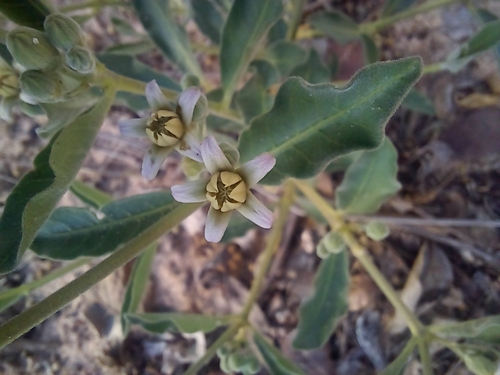
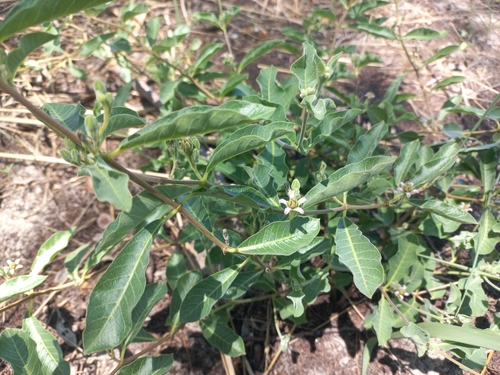
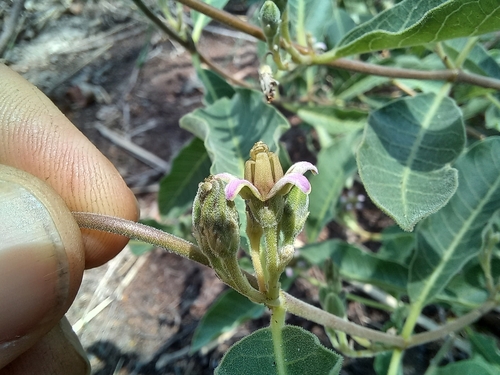
A herb or small shrub. It keeps growing from year to year. It can grow 1 m high. It has a milky latex. It has flattened tubers that are irregular in shape and 35 cm across and 8 cm thick. The leaves are narrowly oval and 4 cm long by 2 cm wide. They have short hairs on the upper surface. The flowers are 10 mm across and light blue. The flowers are in groups or 3-7 in the axils of leaves.
Names & Synonyms
Epepela, Ndandari, Tu-ca-beye, Zurukaka
References (4)
- Fox, F. W. & Young, M. E. N., 1982, Food from the Veld. Delta Books. p 292
- Royal Botanic Gardens, Kew (1999). Survey of Economic Plants for Arid and Semi-Arid Lands (SEPASAL) database. Published on the Internet; http://www.rbgkew.org.uk/ceb/sepasal/internet [Accessed 4th April 2011]
- Welcome, A. K. & Van Wyk, B.-E., 2019, An inventory and analysis of the food plants of southern Africa. South African Journal of Botany 122 (2019) 136–179
- World Checklist of Useful Plant Species 2020. Royal Botanic Gardens, Kew


