Capparis hereroensis
Schinz

(c) Tony Rebelo, some rights reserved (CC BY-SA), uploaded by Tony Rebelo
(c) Nick Helme, some rights reserved (CC BY-NC), uploaded by Nick Helme

(c) Tony Rebelo, some rights reserved (CC BY-SA), uploaded by Tony Rebelo
What to Eat
Edible parts: Fruit
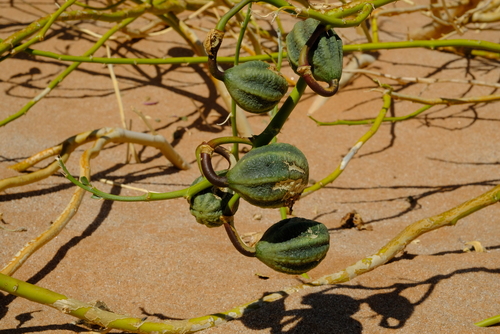
The fruit are eaten raw.
Where to Find It
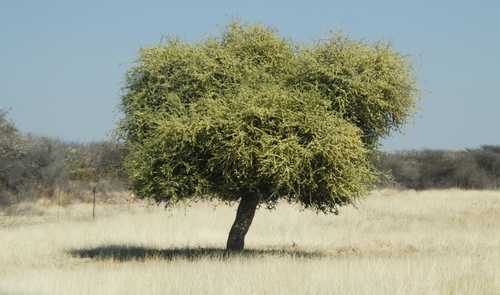
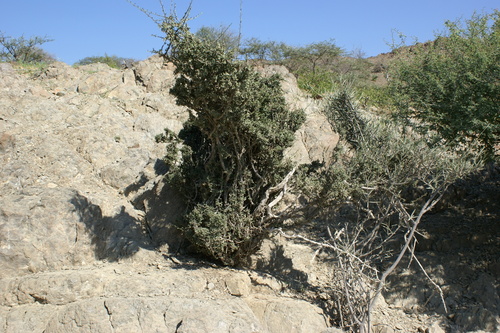
It is a subtropical plant. It suits hot arid places. It can grow in areas with a rainfall less than 50 mm per year. It grows in sandy soils. It grows between 4-30 m above sea level. It grows along the coast. It can grow in arid places. It traps wind blown sand and form hummocks.
Africa, Namibia, Southern Africa,
How to Identify
A thorny shrub. It grows up to 2 m high. The leaf stalks are long. The leaves are alternate and narrowly oval. They have a spine at the tip. The leaves are 3-6 cm long and 1-3 cm wide. They are leathery and hairy. The flowers are cream and turn red. They occur singly in the axils of leaves. They are 3-4 cm across. The fruit are berries. They are 4 cm long. They have dark green lines on the surface.
Names & Synonyms
Mudyangwe, Sirub
References (6)
- Royal Botanic Gardens, Kew (1999). Survey of Economic Plants for Arid and Semi-Arid Lands (SEPASAL) database. Published on the Internet; http://www.rbgkew.org.uk/ceb/sepasal/internet [Accessed 7th April 2011]
- Ruiters-Welcome, A. K., 2019, Food plants of southern Africa. Ph.D. thesis. Univ. of Johannesburg p 41
- Sullivan, S., 1998, People plants and practice in drylands: Socio-political and ecological dimensions of resource-use by Damara farmers in north-west Namibia. Ph.D. Univ. College London. p 28
- Van Damme, P et al, 1922, Plant Uses by the Topnaar of the Kuiseb Valley Namib Desert. Afrika Focus Vol. 8(3-4):223-252
- Welcome, A. K. & Van Wyk, B.-E., 2019, An inventory and analysis of the food plants of southern Africa. South African Journal of Botany 122 (2019) 136–179
- World Checklist of Useful Plant Species 2020. Royal Botanic Gardens, Kew