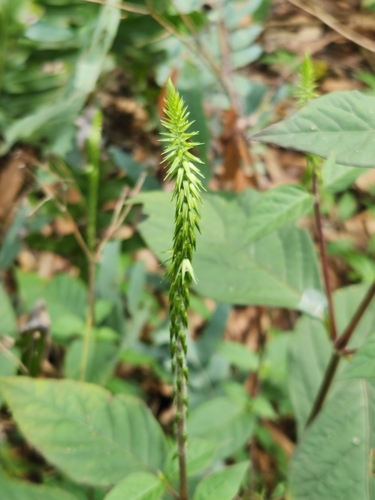
Cornulaca monacantha
Del.
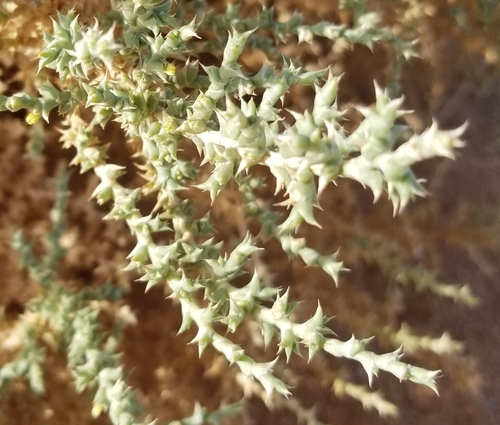
(c) dalil, some rights reserved (CC BY-NC), uploaded by dalil
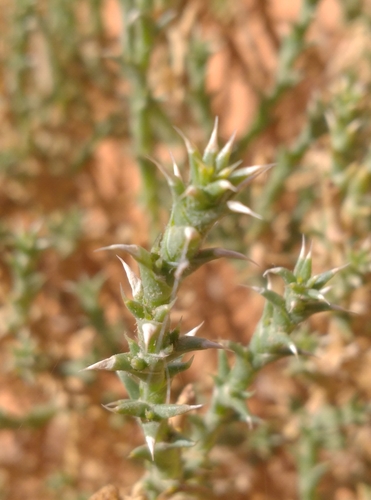
(c) Zaidi, some rights reserved (CC BY-NC), uploaded by Zaidi
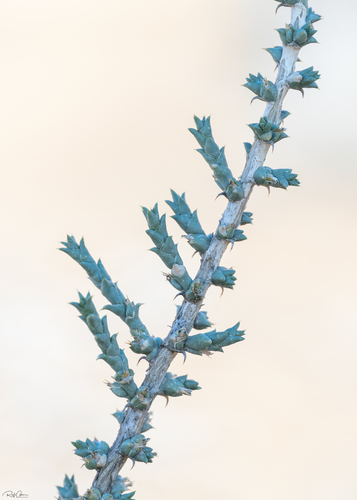
(c) Rafi Amar, some rights reserved (CC BY-NC)
What to Eat
Edible parts: Leaves
The leaves are eaten.
Where to Find It
It grows in tropical and subtropical places. It grows in dry areas. It grows in areas with a rainfall less than 150 mm per year. It can grow in arid places.
Afghanistan, Africa, Algeria, Central Africa, Chad, Egypt, Iran, Iraq, Kuwait, Libya, Mali, Mauritania, Mediterranean, Middle East, Morocco, Niger, North Africa, Oman, Pakistan, Qatar, Sahel, Saudi Arabia, Sudan, Tunisia, United Arab Emirates, UAE, West Africa, Western Sahara, Yemen,
How to Identify
A straggling woody shrub. It grows 60 cm tall. It has a long taproot. The leaves are bluish-green and scale like and clasp the wiry stems. They have a spine at the tip. The flowers occur singly in the axils of the leaves. The flowers are orange-brown. They are spiny. The seeds are in an erect flat seed pod.
Medicinal Uses
A decoction of the leaves of Cornulaca monacantha is used as a traditional medicine for jaundice and liver problems and as a purgative. Externally it is used to treat scabies. Despite its spiny leaves, it provides good grazing for camels and is said to increase the supply of milk produced by lactating females.
Wikipedia
Source ↗Cornulaca monacantha is a species of flowering plant in the genus Cornulaca, that is now included in the family Amaranthaceae, (formerly Chenopodiaceae). It is a desert plant found in the Middle East and the Sahara, and the southern end of its range is considered to delineate the edge of the desert. In Arabic it is known as had and djouri, and the Tuareg people call it tahara. It was first described in 1813 by the French botanist Alire Raffeneau Delile.
Notes
Also put in the family Chenopodiaceae. It is used as medicine.
Names & Synonyms
Djouri, Had, Sely, Tahara, Thalej
References (3)
- Karim, F. M. & Dakheel, A, J., 2006, Salt-tolerant plants of the United Arab Emirates. 2006. International Center for Biosaline Agriculture, Dubai, UAE.
- Royal Botanic Gardens, Kew (1999). Survey of Economic Plants for Arid and Semi-Arid Lands (SEPASAL) database. Published on the Internet; http://www.rbgkew.org.uk/ceb/sepasal/internet [Accessed 8th April 2011]
- World Checklist of Useful Plant Species 2020. Royal Botanic Gardens, Kew