Commelina subulata
Roth
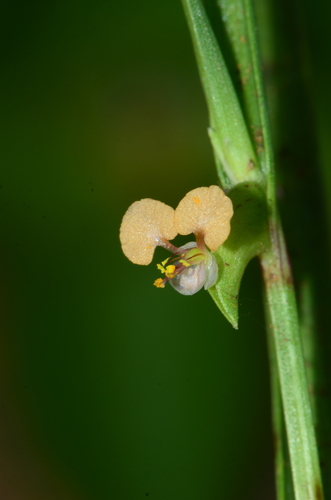
(c) Mayur Nandikar, some rights reserved (CC BY-NC), uploaded by Mayur Nandikar

(c) Andrew Hankey, some rights reserved (CC BY-SA), uploaded by Andrew Hankey

(c) Andrew Hankey, some rights reserved (CC BY-SA), uploaded by Andrew Hankey
What to Eat
Edible parts: Roots
The roots are pounded and added during beer brewing to make beer.
Where to Find It
A subtropical plant. It grows in hot arid regions. It is often in places with a marked dry season. It is often over limestone material. It grows in poorly drained sandy soils. It is often on the edge of pools and in seasonally wet areas. It grows between 380-1,875 m above sea level. It can grow in arid places.
Africa, Botswana, Burkina Faso, East Africa, Eswatini, India, Middle East, Mozambique, Namibia, Saudi Arabia, South Africa, Southern Africa, Swaziland, Zambia, Zimbabwe,
How to Identify
A herb. It has one stem and develops several stems later. It has a bulb. It grows near water. It grows up to 25 cm high. Flowers can be yellow, pink, blue of orange.
Medicinal Uses
The roots are used in traditional beer preparation.
Names & Synonyms
Kaqnibe, Ugo
References (2)
- Royal Botanic Gardens, Kew (1999). Survey of Economic Plants for Arid and Semi-Arid Lands (SEPASAL) database. Published on the Internet; http://www.rbgkew.org.uk/ceb/sepasal/internet [Accessed 10th April 2011]
- World Checklist of Useful Plant Species 2020. Royal Botanic Gardens, Kew


