Convolvulus prostratus
Forsskal

no rights reserved, uploaded by S.MORE
(c) John Pereira, some rights reserved (CC BY-NC), uploaded by John Pereira
What to Eat
Edible parts: Leaves
The leaves are used as a vegetable.
Where to Find It
It is a Mediterranean plant. It grows in dry soils. It can grow in arid places. It grows up to 1,000 m above sea level in Pakistan.
Africa, Asia, Burkina Faso, Egypt, India, Middle East, North Africa, Oman, Pakistan, Qatar, Saudi Arabia, West Africa, Yemen,
How to Identify
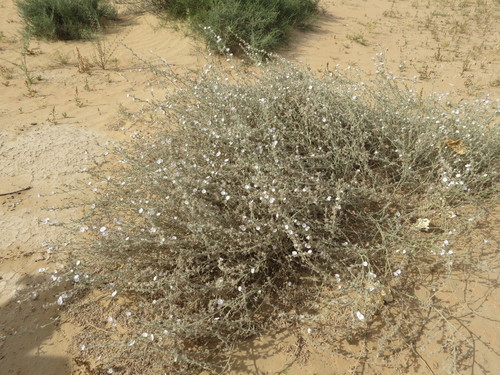
A herb. It keeps growing from year to year. It has a woody base and grows 10-30 cm tall. It branches from the base. It has a brown covering. The leaves do not have leaf stalks. The leaves are 14-30 mm long by 3-6 mm wide. The flowers are in groups of 1-3 in the axils of leaves. The fruit is a capsule 3 mm across. There are 2-4 dark brown seeds.
Wikipedia
Source ↗Convolvulus prostratus (Convolvulus pluricaulis) is an herb found in India and Burma that is used in Ayurveda. In Ayurveda it is known as shankhpushpi and the preparation shankapushpi is, according to most sources, identical with Convolvulus prostratus, but some say shankapushpi is instead Clitoria ternatea (अपराजिता). Some also say Shankhapushpi is Evolvulus alsinoides, which is another plant of the same family. It has been used traditionally as a brain tonic and is believed to help a wide range of issues. It is believed to have demonstrated potential for anxiolytic, relaxant, and anti-obsessive effects, as well as nootropic effects. Shankhpushpi has been found to help significantly with memory retention. In cholesterol-fed gerbils shankapushpi was observed to have significantly helped reduce serum cholesterol, low density lipoprotein cholesterol, and triglycerides after ninety days. Shankhpushpi also demonstrated a thyroid suppressing effect when administered (at 0.4 mg/kg) to mice with hyperthyroidism. It has been studied for use as anticonvulsant with mixed results.
Names & Synonyms
Dodak, Poprang, Shirin dodak
References (6)
- Ambasta, S.P. (Ed.), 2000, The Useful Plants of India. CSIR India. p 139 (As Convolvulus pleuricaulis)
- Awan, M. R., et al, 2011, Studies on traditional knowledge of economically important plants of Kaghan Valley, Mansehra District, Pakistan. Journal of Medicinal Plants Research Vol. 5(16), pp. 3958-3967
- Jabeen, A., et al, 2009, Indigenous uses of economically important flora of Margallah Hills National Park, Islamabad, Pakistan. African Journal of Biotechnology Vol. 8 (5), pp. 763-784
- Mem. Soc. Phys. Geneve 6:477. 1834; Convolv. orient. 95. 1834 (As Convolvulus pluricaulis)
- Royal Botanic Gardens, Kew (1999). Survey of Economic Plants for Arid and Semi-Arid Lands (SEPASAL) database. Published on the Internet; http://www.rbgkew.org.uk/ceb/sepasal/internet [Accessed 14th April 2011]
- Singh, H.B., Arora R.K.,1978, Wild edible Plants of India. Indian Council of Agricultural Research, New Delhi. p 25 (As Convolvulus pleuricaulis)


