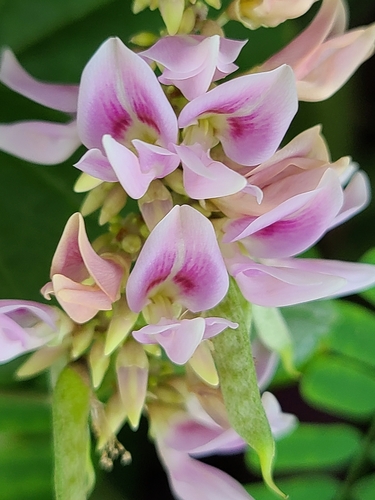
Vachellia robusta
(Burch.) Kyal. & Boatwr.
Splendid thorn, River thorn

(c) Andrew Hankey, some rights reserved (CC BY-SA), uploaded by Andrew Hankey

(c) David Hoare, some rights reserved (CC BY-NC-SA), uploaded by David Hoare

(c) magdastlucia, some rights reserved (CC BY-NC), uploaded by magdastlucia
What to Eat
Edible parts: Gum
The gum is eaten as a snack.
Known Hazards
Where to Find It
It is a subtropical plant. It grows below 1,070 m above sea level. It can grow in arid places.
Africa, Botswana, East Africa, Ethiopia, Mozambique, Namibia, Somalia, South Africa, Southern Africa, Zimbabwe,
How to Identify
A tree. It grows 8 m high. It is spiny. It loses its leaves during the year. The pods are straight and wide. There are 3 subspecies.
How to Grow
A plant of tropical areas, where it can be found at elevations up to 1,800 metres. Plants can tolerate some frost. Established plants are drought resistant. A moderately fast-growing species. Trees resprout well after coppicing. The root system is moderately deep, with strongly spreading lateral roots. This species has a symbiotic relationship with certain soil bacteria, these bacteria form nodules on the roots and fix atmospheric nitrogen. Some of this nitrogen is utilized by the growing plant but some can also be used by other plants growing nearby.
Propagation: Seed - it has a hard seedcoat and may benefit from scarification before sowing to speed up germination. This can usually be done by pouring a small amount of nearly boiling water on the seeds (being careful not to cook them!) and then soaking them for 12 - 24 hours in warm water. By this time they should have imbibed moisture and swollen - if they have not, then carefully make a nick in the seedcoat (being careful not to damage the embryo) and soak for a further 12 hours before sowing. The germination rate of untreated seeds can be very low, often only about 3%, whilst the rate can be up to 90% for treated seeds. Acacia seeds that have matured fully on the bush and have been properly dried have a hard seed coat and can be stored in closed containers without deterioration for 5 - 10 years or more in dry conditions at ambient temperatures. It is best to remove the aril, which attracts weevils and can lead to moulds forming. The arils are easilyremoved by placing the seeds in water and rubbing them between the hands, then drying the seeds and winnowing them.
Medicinal Uses
A decoction of the root is used to treat dysmenorrhoea, female sterility and schistosomiasis. The powdered root is applied to swellings. A decoction of the stem bark has been used to treat gonorrhoea, abdominal pains and skin ailments. The leaves have been used to treat snakebites. The plant (part not specified) has been used to treat malaria and bubonic plague.
Other Uses
The heartwood is pinkish brown to reddish brown; it is distinctly demarcated from the wide layer of whitish sapwood. The texture is moderately coarse to coarse and even; the wood is hard, moderately heavy; brittle; moderately durable but with moderate susceptibility to borer and termite attack. Warping is often considerable during drying. The pulping properties of the wood have been rated as good. The wood is occasionally used for furniture, shelves and yokes, although its use is limited because of the considerable warping. The wood is often used for fuel and, in parts of Kenya, it is the preferred type of firewood and is also used for making charcoal. The energy value of the wood is 18,100 kJ/kg.
Wikipedia
Source ↗Vachellia robusta, the splendid thorn, is an Afrotropical tree species. It is native to eastern and southern Africa, ranging from Ethiopia and Somalia in the north to South Africa and Namibia in southern Africa.
Notes
Also as Mimosaceae.
Names & Synonyms
Mgunga, Moga, Mungi manzi
References (4)
- Royal Botanic Gardens, Kew (1999). Survey of Economic Plants for Arid and Semi-Arid Lands (SEPASAL) database. Published on the Internet; http://www.rbgkew.org.uk/ceb/sepasal/internet [Accessed 27th April 2011]
- Ruiters-Welcome, A. K., 2019, Food plants of southern Africa. Ph.D. thesis. Univ. of Johannesburg p 62
- van Wyk, Ben-Erik, 2019, The diversity and multiple uses of southern African legumes. Australian Systematic Botany, 2019, 32, 519–546
- Welcome, A. K. & Van Wyk, B.-E., 2019, An inventory and analysis of the food plants of southern Africa. South African Journal of Botany 122 (2019) 136–179