Oxygonum delagoense
Kuntze
Salt of the tortoise

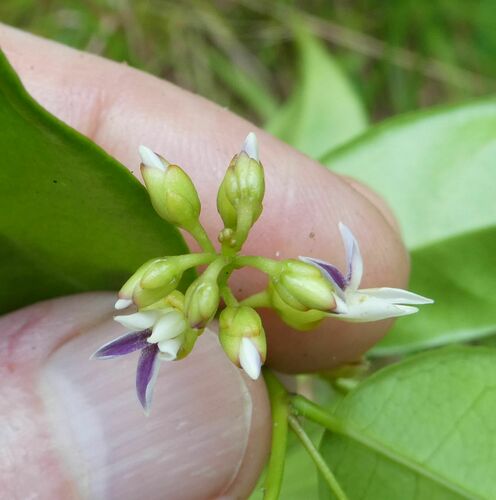
(c) David Hoare, some rights reserved (CC BY-NC-SA), uploaded by David Hoare
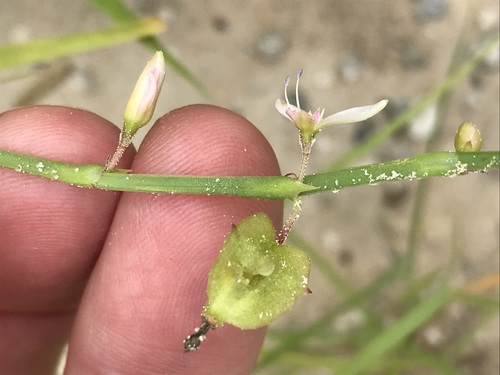
(c) David Hoare, some rights reserved (CC BY-NC-SA), uploaded by David Hoare

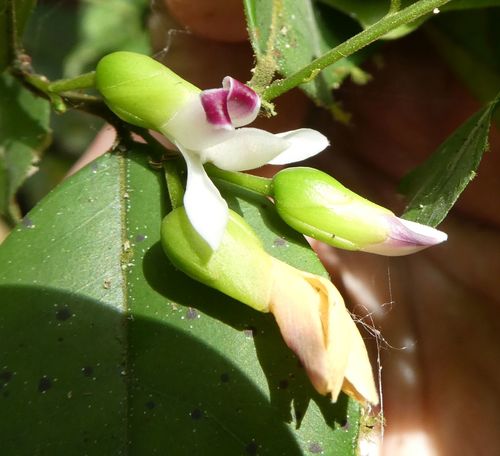
(c) Andrew Hankey, some rights reserved (CC BY-SA), uploaded by Andrew Hankey
What to Eat
Edible parts: Leaves, Fruit
The leaves are eaten cooked and have a moist, acid taste. Both leaves and fruit are eaten as a snack.
Where to Find It
It is a subtropical plant. It grows in hot arid places with a marked dry season. The dry season can be 6-11 months. It is often over limestone material. It grows in well drained sandy material. It grows between 90-1,430 m above sea level. It can grow in arid places.
Africa, Botswana, East Africa, Eswatini, Mozambique, Namibia, South Africa, Southern Africa, Swaziland, Zimbabwe,
How to Identify
A herb. It is an annual plant with a taproot. It grows 60 cm high. The leaves are narrow and sword shaped. They are 6-7 mm long. The flowers are small and white. The fruit are cone shaped.
How to Grow
The plants are polygamous - the flowers can be either bisexual or unisexual.
Names & Synonyms
Compfanhi, Nkopfanhi
References (4)
- Royal Botanic Gardens, Kew (1999). Survey of Economic Plants for Arid and Semi-Arid Lands (SEPASAL) database. Published on the Internet; http://www.rbgkew.org.uk/ceb/sepasal/internet [Accessed 4th June 2011]
- Ruiters-Welcome, A. K., 2019, Food plants of southern Africa. Ph.D. thesis. Univ. of Johannesburg p 91
- Welcome, A. K. & Van Wyk, B.-E., 2019, An inventory and analysis of the food plants of southern Africa. South African Journal of Botany 122 (2019) 136–179
- World Checklist of Useful Plant Species 2020. Royal Botanic Gardens, Kew