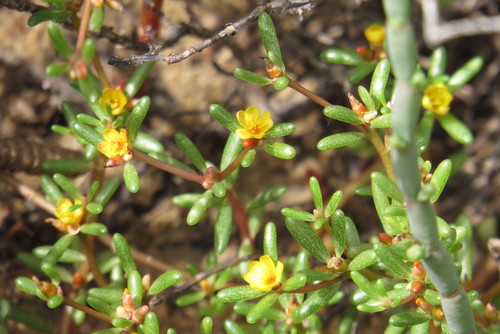
Calyptrotheca somalensis
Gilg

iNaturalist · cc-by
(c) Seig, some rights reserved (CC BY)
(c) Seig, some rights reserved (CC BY)

iNaturalist · cc-by
(c) Seig, some rights reserved (CC BY)
(c) Seig, some rights reserved (CC BY)

iNaturalist · cc-by
(c) Seig, some rights reserved (CC BY)
(c) Seig, some rights reserved (CC BY)
What to Eat
Edible parts: Sap, Root sap - thirst
The sap is consumed as a drink to quench thirst.
Where to Find It
It is a tropical plant. It grows in dry soils. It grows in areas with an annual rainfall above 400 mm. It can grow in arid places.
Africa, East Africa, Ethiopia, Kenya, Somalia,
Countries: Angola, Burkina Faso, Burundi, Benin, Botswana, Congo (DRC), Central African Republic, Congo (Republic), Cote d'Ivoire, Cameroon, Cape Verde, Djibouti, Algeria, Egypt, Eritrea, Ethiopia, Gabon, Ghana, Gambia, Guinea, Equatorial Guinea, Guinea-Bissau, Kenya, Comoros, Liberia, Lesotho, Libya, Morocco, Madagascar, Mali, Mauritania, Mauritius, Malawi, Mozambique, Namibia, Niger, Nigeria, Rwanda, Seychelles, Sudan, Sierra Leone, Senegal, Somalia, South Sudan, Sao Tome & Principe, Eswatini, Chad, Togo, Tunisia, Tanzania, Uganda, South Africa, Zambia, Zimbabwe
How to Identify
A shrub. It lies along the ground. The stems and leaves are succulent. It grows 3 m high. It has a large fleshy, tuberous rootstock. The leaves are oval with wavy edges. They are 2.5 cm long by 1-3 cm wide. The flowers are greenish or white. They are 4-20 in a cluster. They are at the ends of the small branches. The fruit are oval and yellow. They are 1 cm long and have 1 seed. The seed is black with a red, loved aril.
Names & Synonyms
Dalol, Duhn, Mukhudu-nyuma, Solol
Talinum rivae Chiov.
References (3)
- Mutie, F. M., et al, 2023, Important Medicinal and Food Taxa (Orders and Families) in Kenya, Based on Three Quantitative Approaches. Plants 2023, 12, 1145
- Royal Botanic Gardens, Kew (1999). Survey of Economic Plants for Arid and Semi-Arid Lands (SEPASAL) database. Published on the Internet; http://www.rbgkew.org.uk/ceb/sepasal/internet [Accessed 6th June 2011]
- World Checklist of Useful Plant Species 2020. Royal Botanic Gardens, Kew
More from Portulacaceae

Calandrinia ciliata menziesii - (Hook.f.)MacBr.
Redmaids

Lewisia brachycalyx
Shortsepal lewisia

Lewisia columbiana - (Howell.)B.L.Rob.
Columbian Bitterroot, Columbian lewisia, Wallowa lewisia

Lewisia pygmaea - (A.Gray.)B.L.Rob.
Pigmy Bitterroot, Alpine lewisia

Lewisia rediviva
Bitter-Root
Portulaca australis
Inland pigweed