Portulaca australis
Endl.
Inland pigweed
(c) coenobita, some rights reserved (CC BY), uploaded by coenobita
(c) coenobita, some rights reserved (CC BY), uploaded by coenobita
(c) coenobita, some rights reserved (CC BY), uploaded by coenobita
What to Eat
Edible parts: Root
The roots are roasted and eaten.
Dangerous Lookalikes
This plant can be confused with the following toxic species. Always verify identification carefully before consuming any wild plant.


Spotted Spurge: Milky white latex sap when broken, thinner leaves often with dark spot, prostrate growth, tiny flowers.
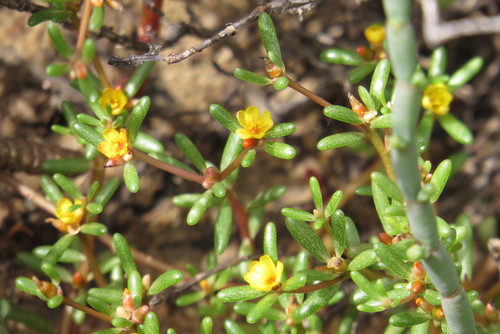
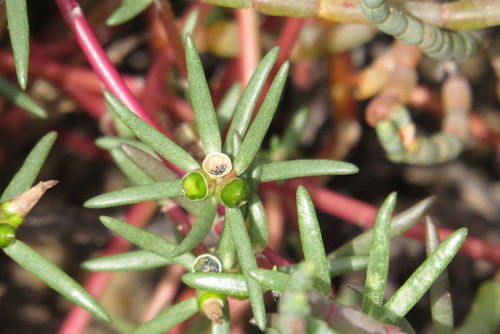
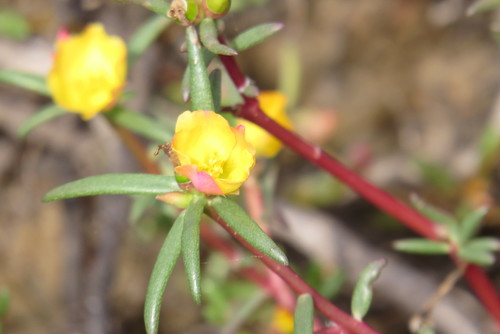
Inland pigweed: Clear sap, thick succulent leaves, reddish smooth stems, yellow flowers.
Where to Find It
It is a tropical plant.
Australia, East Timor, Kiribati, Micronesia, Pacific, Palau, SE Asia, Timor-Leste, Tuvalu,
How to Identify
A herb. It has a tuberous root. The leaves are narrow and slightly flattened. They are small. They can be 1 cm long by 0.5 cm wide. The flowers are yellow to orange. They can be 1 cm across.
Notes
There are about (40) 200 Portulaca species. They are mostly in the tropics and subtropics.
Names & Synonyms
Me-mama, Te mtea
References (8)
- Bailey, F. M., 1913, Comprehensive Catalogue of Queensland Plants. Queensland Government. p 49
- Cowie, I, 2006, A Survey of Flora and vegetation of the proposed Jaco-Tutuala-Lore National Park. Timor-Lests (East Timor) www.territorystories.nt/gov.au p 52
- Cribb, A.B. & J.W., 1976, Wild Food in Australia, Fontana. p 153
- Elliot, W.R., & Jones, D.L., 1997, Encyclopedia of Australian Plants suitable for cultivation. Vol 7. Lothian. p 444
- Lim, T. K., 2015, Edible Medicinal and Non Medicinal Plants. Volume 9, Modified Stems, Roots, Bulbs. Springer p 68
- Smith, K & I., 1999, Grow your own bushfoods. New Holland. Australia. p 72
- Thaman, R. R., 1987, Plants of Kiribati: A listing and analysis of vernacular names. Atoll Research Bulletin No. 296
- Thaman, R. R, 2016, The flora of Tuvalu. Atoll Research Bulletin No. 611. Smithsonian Institute p 107
More from Portulacaceae


