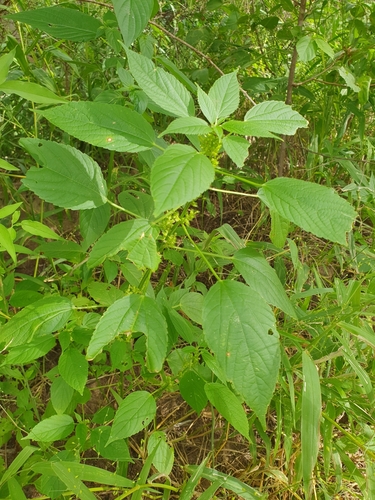
Erythrococca anomala
(Juss. ex Poir.) Prain
Bush lime

Ehoarn Bidault

Ehoarn Bidault

Ehoarn Bidault
Where to Find It
It is a tropical plant. It grows in forests.
Africa, Guinea, Guinée, Guinea-Bissau, Sierra Leone, West Africa,
How to Identify
A small shrub.
How to Grow
Grows best in a sunny position. A fast-growing plant. A dioecious species, both male and female forms need to be grown if fruit and seed are required.
Medicinal Uses
The leaves are analgesic, antiseptic, laxative, purgative, and are considered very effective against tapeworm. A decoction of the leaves is taken to expel tapeworms. The dried and ground leaves, combined with the seeds of melegueta pepper (Aframomum melegueta) is taken as a snuff against chronic headache. Leafy twigs are used to clean and disinfect wounds and ulcers. A decoction of young leaves is applied topically as a treatment for skin lesions and subcutaneous parasites. The sap of the leaves is used as eye drops to treat sore eyes; as nose drops to treat sinusitis; and as ear drops to treat ear infections. To treat eye injuries, the leaves are folded into a funnel and filled with water; after a while the water is dropped into the eye. Leaf pulp is also used as a rub to treat local pain. The dried and powdered leaves, either alone or combined with those of Psychotria peduncularis, are mixed with clay and applied in a friction as a treatment for malaria in children, and are rubbed on the neck and throat as a treatment fort meningitis. A leaf macerate is applied to the tooth to treat toothache. The bark is used as a treatment for arthritis and rheumatism. It is appied topically to treat localized pain. The fruit pulp or the root bark are taken as a tonic to remedy general weakness. The roots and bark contain about 1% alkaloids, the twigs and leaves about 0.1%. Alkaloids have also been found in the seeds.
Names & Synonyms
References (2)
- FAO Country report Sierra Leone
- World Checklist of Useful Plant Species 2020. Royal Botanic Gardens, Kew