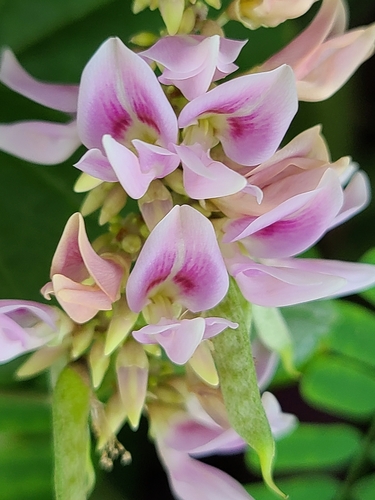
Desmodium renifolium
(L.) Schindler

iNaturalist · cc-by-nc
(c) Joyce Tu, some rights reserved (CC BY-NC)
(c) Joyce Tu, some rights reserved (CC BY-NC)

iNaturalist · cc-by-nc
(c) Joyce Tu, some rights reserved (CC BY-NC)
(c) Joyce Tu, some rights reserved (CC BY-NC)

iNaturalist · cc-by-nc
(c) Joyce Tu, some rights reserved (CC BY-NC)
(c) Joyce Tu, some rights reserved (CC BY-NC)
Where to Find It
It is a tropical plant. It grows in sunny grasslands and broad-leaved forests between 100-1,000 m above sea level in southern China. In Yunnan.
Asia, Australia, Cambodia, China, Himalayas, India, Indochina, Indonesia, Laos, Malaysia, Myanmar, Nepal, SE Asia, Thailand, Vietnam,
Countries: United Arab Emirates, Afghanistan, Armenia, Australia, Azerbaijan, Bangladesh, Bahrain, Brunei, Bhutan, China, Georgia, Indonesia, Israel, India, Iraq, Iran, Jordan, Japan, Kyrgyzstan, Cambodia, North Korea, South Korea, Kuwait, Kazakhstan, Laos, Lebanon, Sri Lanka, Myanmar, Mongolia, Maldives, Malaysia, Nepal, Oman, Philippines, Pakistan, Qatar, Saudi Arabia, Singapore, Syria, Thailand, Tajikistan, Timor-Leste, Turkmenistan, Turkey, Taiwan, Uzbekistan, Vietnam, Yemen
How to Identify
A small shrub. It grows 30-50 cm tall. The leaves have one leaflet. It is kidney shaped and 2-4 cm long by 3-5 cm wide. There are 2-5 flowers at each node of the flowering groups. They can be white, pale yellow or purple. The pod is oblong and 2-3 cm long by 3-4 mm wide.
Names & Synonyms
Kayu-pin pauk
Hedysarum renifolium L.
References (1)
- Anderson, E. F., 1993, Plants and people of the Golden Triangle. Dioscorides Press. p 209