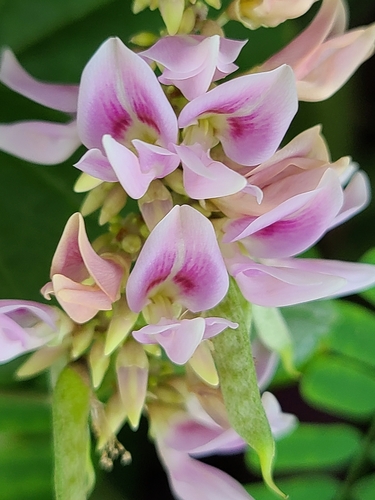
Mucuna macrocarpa
Wallich
Large fruited mucuna
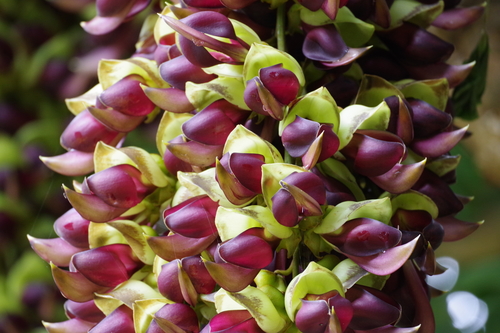
(c) Takaaki Hattori, some rights reserved (CC BY), uploaded by Takaaki Hattori
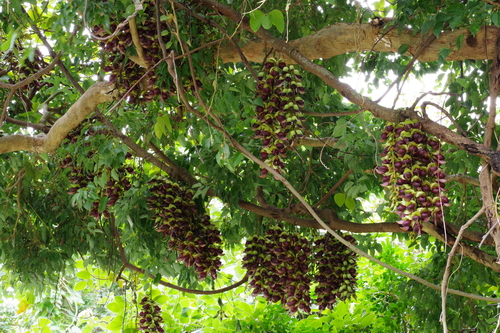
(c) Takaaki Hattori, some rights reserved (CC BY), uploaded by Takaaki Hattori

(c) 桃子, some rights reserved (CC BY-NC), uploaded by 桃子
What to Eat
Edible parts: Flower, Leaves
The flowers are eaten as a potherb, and the leaves are also edible.
Where to Find It
It is a tropical plant. It grows in forests on dry sandy land between 800-3,000 m above sea level. In Yunnan.
Asia, Bhutan, China, Himalayas, India, Indochina, Japan, Laos, Myanmar, Nepal, SE Asia, Taiwan, Thailand, Vietnam,
How to Identify
A large woody vine. The young stems have fine hairs. The leaves are 25-33 cm long. They have leaflets that are oval and 10-19 cm long by 5-10 cm wide. The flowering stalks arise from old stems and are 5-23 cm long. The flowers are greenish white with purple wings. The pods are 26-48 cm long by 3-5 cm wide and 7-10 mm thick. There are 6-15 seeds that are disk shaped and 2-3 cm long by 2-3 cm wide and 5-10 mm thick.
How to Grow
Plants can be grown from seed.
Names & Synonyms
Baldangra, Gua la lu, Ke tuo, Ne qi a yi, Pangra, Pauk-net
References (3)
- Anderson, E. F., 1993, Plants and people of the Golden Triangle. Dioscorides Press. p 216
- Cao, Y., et al, 2020, Ethnobotanical study on wild edible plants used by three trans-boundary ethnic groups in Jiangcheng County, Pu’er, Southwest China. Journal of Ethnobiology and Ethnomedicine (2020) 16:66
- Sutjaritjai, N., et al, 2019, Traditional Uses of Leguminosae among the Karen in Thailand. Plants 2019, 8, 600 p 7