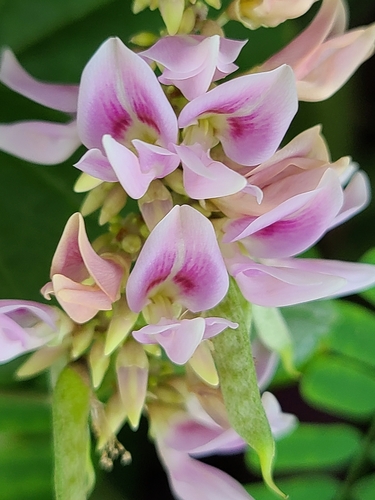
Uraria picta
(Jacq.) DC.

(c) Mathias D'haen, some rights reserved (CC BY-NC), uploaded by Mathias D'haen

(c) Mathias D'haen, some rights reserved (CC BY-NC), uploaded by Mathias D'haen
(c) Anne-Hélène Paradis, some rights reserved (CC BY-NC), uploaded by Anne-Hélène Paradis
What to Eat
Edible parts: Fruit
The ripe fruits are eaten raw.
Where to Find It
It is a tropical plant. In East Africa it grows from sea level to 2,400 m above sea level. It grows on flood plains and marshy lands. It can be in wet grassland savannah and along river banks. In China it grows on grassy slopes between 400-1,500 m above sea level.
Africa, Angola, Asia, Australia, Bangladesh, Bhutan, Burkina Faso, Cambodia, China, Côte d'Ivoire, East Africa, Guinea, Guinée, Guinea-Bissau, Himalayas, India, Indochina, Ivory Coast, Japan, Malaysia, Mali, Myanmar, Nepal, Pakistan, Ryukyu, Sao Tome and Principe, SE Asia, Senegal, Sierra Leone, Sri Lanka, Taiwan, Thailand, Vietnam, West Africa, Zimbabwe,
How to Identify
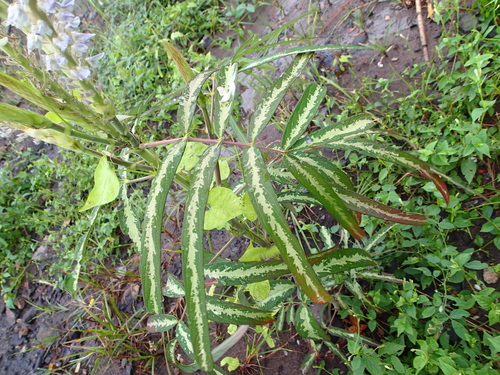
A tall herb or shrub. It keeps growing from year to year. It can grow up to 1.8 m tall. The stems have short rough hairs. The leaves are compound. They have 5-9 leaflets at one at the end. The lower most leaflets have 3 lobes. The leaflets are narrowly sword shaped and 7-25 cm long. They are rough and hairy underneath. There are many flowers in a long dense spike at the ends of the branches. These can be 55 cm long. The flowers are pink, blue or red. The fruit are 5-9 mm long.
Medicinal Uses
The roots are used in medicine.
Wikipedia
Source ↗Uraria picta, also known by its common name Prishniparni is a species from the genus Uraria. The species was described in 1825.
Other Information
It is fairly commonly eaten in West Africa.
Notes
The roots are used in medicine.
Names & Synonyms
Alagno, Dabra, Hauvi mau, Kamaring kouliho, Kyemi-ma, Pithwan, Zumbu
References (4)
- Ambe, G., 2001, Les fruits sauvages comestibles des savanes guinéennes de Côte-d’Ivoire : état de la connaissance par une population locale, les Malinké. Biotechnol. Agron. Soc. Environ. 5(1), 43-48
- Diarra, N. et al, 2016, Etude ethnobotanique des plantes alimentaires utilisées en période de soudure dans les régions Sud du Mali. Int. J. Biol. Chem. Sci. 10(1): 184-197
- Khayde, M. S., et al, 2009, Wild Edible Plants Used by the tribes of Akole Tahasil of Ahmednagar District (MS), India. Ethnobotanical Leaflets 13:1328-36
- World Checklist of Useful Plant Species 2020. Royal Botanic Gardens, Kew