Carissa macrocarpa
(Ecklon) A. DC.
Natal plum, Large num-num, Carissa
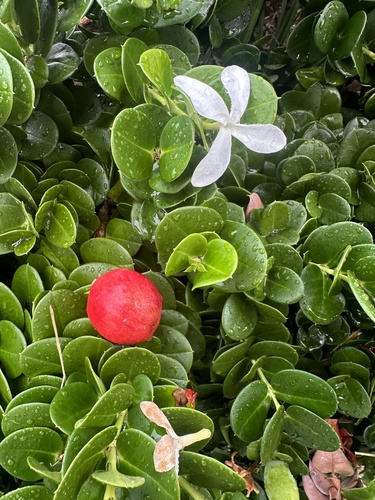
(c) framingjune, some rights reserved (CC BY-NC)
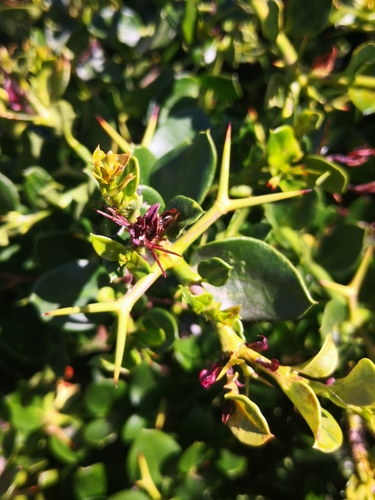
(c) Hayley-May Wittridge, some rights reserved (CC BY-NC), uploaded by Hayley-May Wittridge

(c) maryannrobledo, some rights reserved (CC BY-NC)
What to Eat
Edible parts: Fruit
Partly ripe fruits are used for jelly, while fully ripe fruit is eaten fresh, made into pies, jam, chutney, or juice. Fruit can also be frozen, dried, or bottled for later use. Seeds are edible.
Where to Find It
A subtropical and tropical plant. The plant grows in warm moist tropical regions. It will also grow in the dry subtropics if temperatures do not reach freezing. They can survive drought. They will grow on sandy soils. They do best on well drained soils. They do best in full sunlight but can tolerate light shade. It suits hardiness zones 10-12. In Wittunga Botanical Gardens Adelaide.
Africa, Asia, Australia, Bahamas, Brazil, Canada, Caribbean, China, Colombia, Cuba, Dominica, East Africa, El Salvador, Ethiopia, Hawaii, Honduras, India, Indonesia, Jamaica, Kenya, Leeward Is., Malawi, Marianas, Mexico, Mozambique, Nicaragua, North America, Pacific, Philippines, Puerto Rico, SE Asia, Slovenia, South Africa*, Southern Africa, South America, Tanzania, Trinidad-Tobago, USA, West Indies, Zambia, Zimbabwe,
How to Identify
A small evergreen shrub. It grows up to 5 m tall. It branches densely and has many forked spines. They are usually in pairs at the top of shoots. The branches are smooth and light brown. branches exude milky latex when cut. The leaves are produced opposite one another. They are simple leaves with short stalks. The leaves are oval and shiny. The top surface is dark green and the lower surface is paler green. The leaf has a thorn like tip. The flowers are in clusters at the ends of twigs. The flowers are 5 cm across and white. They have a sweet smell. The flowers a like tubes and the petals spread out. The fruit are oval red berries. They are 2.5-5 cm long. They are produced on the tips of young shoots. Seeds are flat and papery. The number of seeds varies. The fruit are edible.
Nutrition Score: 32/100
| Part | Moisture | kJ | kcal | Protein | Vit A | Vit C | Iron | Zinc |
|---|---|---|---|---|---|---|---|---|
| Fruit | 84.2 | 259 | 62 | 0.5 | 4 | 38 | 1.3 | — |
How to Grow
The plant can be grown from seed or cuttings. They can also be grown using layering or budding. Cuttings need to be put in soil with bottom heat to produce roots. To maintain good quality fruit, vegetative methods are best. Plants with shrubby growth habit normally are more productive than straggly types. Regular pruning helps increase fruit production by avoiding excessive branch growth. For use in hedges, plants are grown in nurseries then planted out 30 cm apart in staggered rows.
Propagation: Seed - best sown as soon as ripe. Heeled, semi-ripe cuttings of side shoots. Layering.
Medicinal Uses
The fruit are important in traditional use in Natal province during January and February.
Other Uses
The plant can be grown as a hedge. It is normally heavily pruned to form a thorny dense barrier that can keep animals out.
Wikipedia
Source ↗Carissa macrocarpa is a shrub native to tropical and southern Africa. It is commonly known as the Natal plum, amathungulu, big num-num or large num-num. Carissa macrocarpa deals well with salt-laden winds, making it a good choice for coastal areas. It is commonly found in the coastal bush of the Eastern Cape and Natal. It produces shiny, deep green leaves and snowy white flowers whose perfumed scent intensifies at night. Like other Carissa species, C. macrocarpa is a spiny, evergreen shrub containing latex. They bloom for months at a time. The ornamental plump, round, crimson fruit appears in summer and fall (autumn) at the same time as the blooms. In moderate, coastal areas the fruits appear through the year. The fruit can be eaten out of hand or made into pies, jams, jellies, and sauces. Some claim that other than the fruit, the plant is poisonous. However, this claim is a myth, possibly based on similarities to other plants with milky sap. The College of Agricultural and Environmental Sciences at University of California, Davis rates the plant as mildly toxic. It appears in the South African National tree list as number 640.3. A traditional food plant in Africa, this little-known fruit has potential to improve nutrition, boost food security, foster rural development and support sustainable landcare.
Production
Plants grow rapidly under suitable conditions. Plants flower and fruit throughout most of the year. Most fruit occur in the summer months. A fruit weighs about 14 g.
Other Information
The fruit are important in Natal province in January and February. It is a cultivated food plant.
Notes
There about 20-37 Carissa species. All Carissa species bear edible fruit. They grow in the tropics and subtropics.
Names & Synonyms
Amanthungula, Cereza de natal, Da hua jia hu ci, Kiskis natal, Mbanza, Umthungulu


