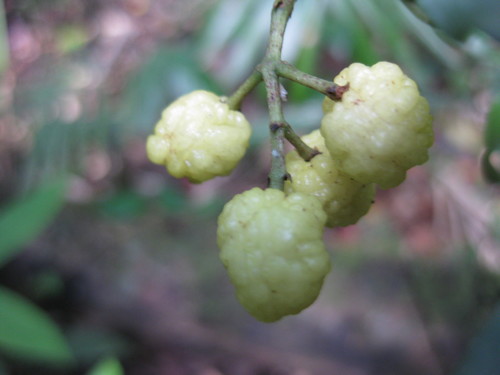
Citrus halimii
Stone
Limau hutan

(c) WinWin Rider พี่ช้างชวนเที่ยว, some rights reserved (CC BY-NC), uploaded by WinWin Rider พี่ช้างชวนเที่ยว

President and Fellows of Harvard College
What to Eat
Edible parts: Fruit
The fruit is eaten fresh and used as a flavoring.
Where to Find It
It is a tropical plant. It grows between 900-1,800 m above sea level.
Asia, Indochina, Malaysia, SE Asia, Thailand,
How to Identify
A medium sized tree. It can be 25 m tall. The trunk is 60 cm across. The crown is small with a few branches that curve upwards. The young plants have a few spines on the branches. The leaves have one leaflet. These are narrowly oval and 8-15 cm long by 4-8 cm wide. They are thinly leathery. The leaf stalks are 1-2 cm long. There can be very narrow wings. The flowers occur singly. The fruit are a long round or pear shape. They are 5-7 cm across. They are green ut turn yellow when ripe. There are several seeds.
Wikipedia
Source ↗Citrus halimii, or mountain citron, is a citrus with sour fruit. Historically placed within the polyphyletic grouping of papedas, it has since been determined to be a wild species most closely related to the kumquats, and is not related to the true citron. It was first discovered and catalogued in 1973.
References (1)
- Soepadmo, E. and Wong, K. M., 1995, Tree Flora of Sabah and Sarawak. Forestry Malaysia. Volume One. p 365