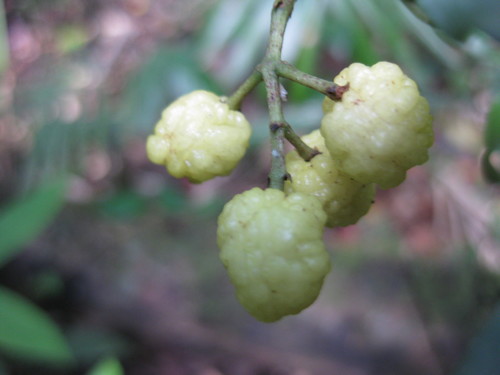
Severinia disticha
(Blanco) Swingle
RutaceaeFruit

wikimedia · cc-by-sa
Wikimedia Commons - User:Zenwort
Wikimedia Commons - User:Zenwort

wikimedia · cc-by-sa
Wikimedia Commons - User:Zenwort
Wikimedia Commons - User:Zenwort
What to Eat
Edible parts: Fruit
The ripe fruit is eaten fresh.
Where to Find It
It is a tropical plant. It grows near the coast and up to 90 m above sea level.
Asia, Indochina, Indonesia, Malaysia, Philippines, Papua, SE Asia, Vietnam,
Countries: United Arab Emirates, Afghanistan, Armenia, Azerbaijan, Bangladesh, Bahrain, Brunei, Bhutan, China, Georgia, Indonesia, Israel, India, Iraq, Iran, Jordan, Japan, Kyrgyzstan, Cambodia, North Korea, South Korea, Kuwait, Kazakhstan, Laos, Lebanon, Sri Lanka, Myanmar, Mongolia, Maldives, Malaysia, Nepal, Oman, Philippines, Pakistan, Qatar, Saudi Arabia, Singapore, Syria, Thailand, Tajikistan, Timor-Leste, Turkmenistan, Turkey, Taiwan, Uzbekistan, Vietnam, Yemen
How to Identify
A shrub or small tree. It grows 10 m tall. The trunk is 15 cm across. The leaves are 3-8 cm long by 3-4 cm wide. They are oval or sword shaped. There are 15-20 pairs of parallel veins. The flowering stalks have many flowers. They are usually in the axils of leaves. They are 3-9 cm long. The fruit are a flattened round shape 1.5 cm across. They become purple to black when ripe. The flesh is green and juicy. There are 1-2 seeds.
Names & Synonyms
Limonia disticha BlancoLimonia corymbosa BlancoAtalantia nitida Oliv.Atalantia disticha (Blanco) Merr.
References (2)
- Martin, F. W., et al, 1987, Perennial Edible Fruits of the Tropics. USDA Handbook 642 p 75
- Soepadmo, E. and Wong, K. M., 1995, Tree Flora of Sabah and Sarawak. Forestry Malaysia. Volume One. p 411