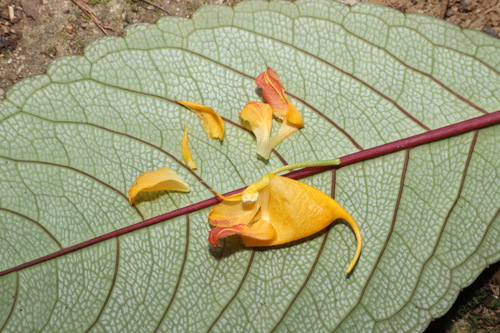
Impatiens macroptera
Hook. f.
BalsaminaceaeLeaves

gbif · cc-by-nc-nd
Vincent Droissart
Vincent Droissart

gbif · cc-by-nc-nd
Vincent Droissart
Vincent Droissart
What to Eat
Edible parts: Leaves, Vegetable
The leaves are eaten as a vegetable.
Where to Find It
It is a tropical plant. It grows between 600-1,350 m above sea level. It grows in humid, shaded forest.
Africa, Cameroon, Central Africa, Congo, Equatorial Guinea, Gabon, Nigeria, West Africa,
Countries: Angola, Burkina Faso, Burundi, Benin, Botswana, Congo (DRC), Central African Republic, Congo (Republic), Cote d'Ivoire, Cameroon, Cape Verde, Djibouti, Algeria, Egypt, Eritrea, Ethiopia, Gabon, Ghana, Gambia, Guinea, Equatorial Guinea, Guinea-Bissau, Kenya, Comoros, Liberia, Lesotho, Libya, Morocco, Madagascar, Mali, Mauritania, Mauritius, Malawi, Mozambique, Namibia, Niger, Nigeria, Rwanda, Seychelles, Sudan, Sierra Leone, Senegal, Somalia, South Sudan, Sao Tome & Principe, Eswatini, Chad, Togo, Tunisia, Tanzania, Uganda, South Africa, Zambia, Zimbabwe
How to Identify
A herb that keeps growing from year to year. It grows 50 cm high. It has red flowers.
Medicinal Uses
The leaves are eaten as a cure for heart troubles and illnesses caused by evil spirits. The leaves are used to make poultices and dressings to treat wounds and sores and to alleviate all kinds of painful conditions. The flavonoids procyanidin and prodelphidin have been isolated from the sepals and petals.
References (2)
- Grubben, G. J. H. and Denton, O. A. (eds), 2004, Plant Resources of Tropical Africa 2. Vegetables. PROTA, Wageningen, Netherlands. p 332
- World Checklist of Useful Plant Species 2020. Royal Botanic Gardens, Kew