Aruncus sylvester
Kostel. ex Maxim.
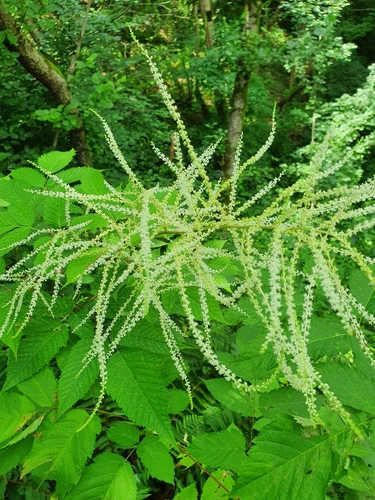
(c) Pelagiya Belyakova, some rights reserved (CC BY-NC), uploaded by Pelagiya Belyakova
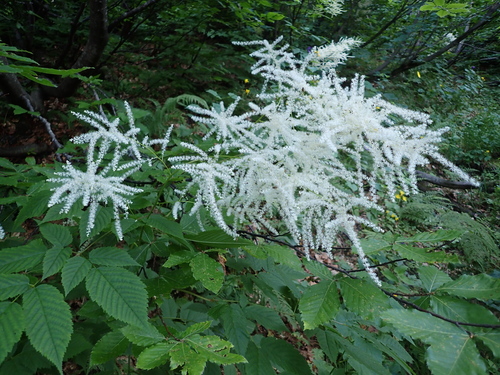
(c) Evgeny Pervakov, some rights reserved (CC BY-NC), uploaded by Evgeny Pervakov
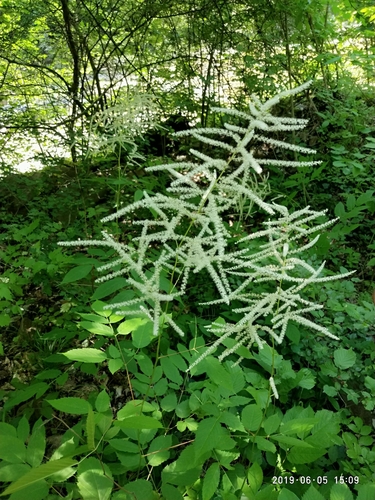
(c) Сергей Крыленко, some rights reserved (CC BY), uploaded by Сергей Крыленко
What to Eat
Edible parts: Shoots, Stem, Leaves, Vegetable
The shoots, stems, and leaves are eaten as a vegetable.
Where to Find It
It is a temperate plant. It grows in mixed forests on mountain slopes between 1,800-3,500 m above sea level.
Alaska, Asia, Bhutan, China, Himalayas, India, Japan, Korea, Mongolia, Nepal, North America, Northeastern India, Russia, Sikkim,
How to Identify
A shrub. It grows 3 m tall. The stems are woody at the base. The stems are dark purple. The leaves have 2 or 3 leaflets along the stalk. The leaflets are narrow and 5-13 cm long by 2-8 cm wide.
Wikipedia
Source ↗Aruncus sylvester, the goat's beard, is a species of flowering plant in the family Rosaceae, found from the Himalayas to the Russian Far East and Japan. As its synonym Aruncus aethusifolius it has gained the Royal Horticultural Society's Award of Garden Merit.
Names & Synonyms
References (4)
- Chen, B. & Qiu, Z., Consumer's Attitudes towards Edible Wild Plants, Ishikawa Prefecture, Japan. p 22 www.hindawi.com/journals/ijfr/aip/872413.pdf (As Aruncus dioicus var. tenuifolius)
- Flora of China. www.eFloras.org Volume 9
- Urgamal, M., Oyuntsetseg, B., Nyambayar, D. & Dulamsuren, Ch. 2014. Conspectus of the vascular plants of Mongolia. (Editors: Sanchir, Ch. & Jamsran, Ts.). Ulaanbaatar, Mongolia. “Admon“ Press. 334pp. (p. 143-158).
- Zhang, L., et al, 2016, Ethnobotanical study of traditional edible plants used by the Naxi people during droughts. Journal of Ethnobiology and Ethnomedicine. 12:39
More from Rosaceae


