Carpobrotus modestus
S. T. Blake
Inland pigface
(c) Reiner Richter, some rights reserved (CC BY-NC-SA), uploaded by Reiner Richter

(c) Lorraine Phelan, some rights reserved (CC BY-NC), uploaded by Lorraine Phelan
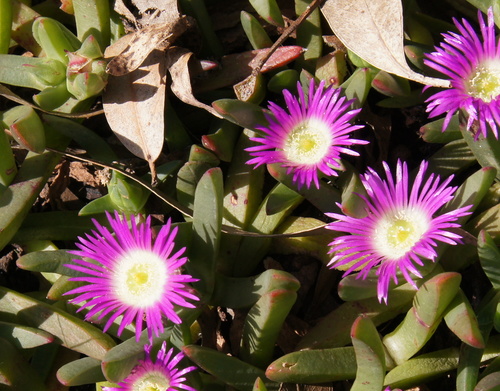
(c) Reiner Richter, some rights reserved (CC BY-NC-SA), uploaded by Reiner Richter
What to Eat
Edible parts: Fruit, Leaves
None known.
Where to Find It
Temperate. It grows on white or grey sand and clay. It grows in warm temperate and subtropical places. It is best in light to medium well-drained soils. It needs a sunny position. It is resistant to drought and frost.
Australia*,
How to Identify
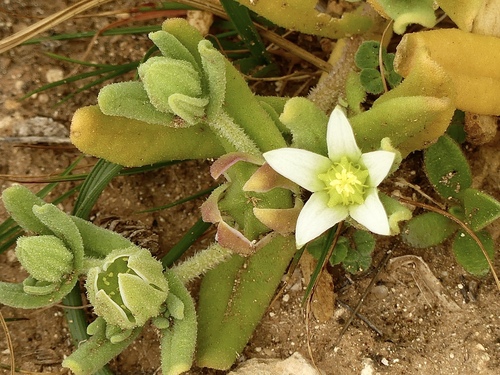
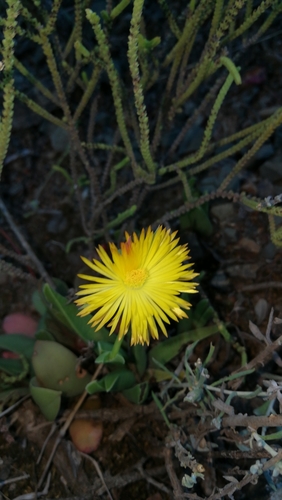
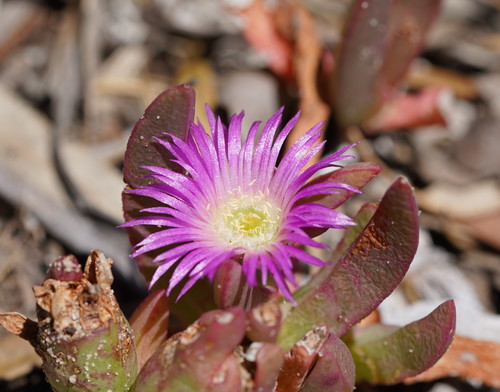
A succulent herb. It lies along the ground and grows from year to year. It grows 6-50 cm high. It spreads 1 m wide. The flowers are pink, purple, blue and mauve.
Nutrition Score: 28/100
| Part | Moisture | kJ | kcal | Protein | Vit A | Vit C | Iron | Zinc |
|---|---|---|---|---|---|---|---|---|
| Fruit | 68.4 | 278 | 67 | 3.7 | — | — | 2.7 | 0.9 |
| Leaves | 91 | 52 | 12 | 0.4 | — | — | 0.7 | 0.3 |
How to Grow
It can be grown by seed or cuttings.
Medicinal Uses
None known.
Other Uses
None known.
Wikipedia
Source ↗Carpobrotus modestus, commonly known as inland pigface, is a succulent perennial of the family Aizoaceae, native to Australia. It produces purple flowers which mature into fruits. It is mainly used as a groundcover succulent or as a drought tolerant plant.
Notes
There are about 25 Carpobrotus species. Also put in the family Mesembryanthemaceae.
Names & Synonyms
Katwort, Keong-a
References (13)
- Bodkin, F., 1991, Encyclopedia Botanica. Cornstalk publishing, p 217
- Bonney, N., 2012, Edible Wild Native Plants for Southern Australia. p 28
- De Angelis, D., 2005, Aboriginal Plant Use of the Greater Melbourne Area. La Trobe University Environment Collective
- Elliot, W.R., & Jones, D.L., 1982, Encyclopedia of Australian Plants suitable for cultivation. Vol 2. Lothian. p 466
- Flora of Australia, Volume 4, Phytolaccaceae to Chenopodiaceae, Australian Government Publishing Service, Canberra (1984) p 27
- Greig, D., 1996, Flowering Natives for Home Gardens. Angus & Robertson. p 107
- Hibbert, M., 2002, The Aussie Plant Finder 2002, Florilegium. p 60
- Lazarides, M. & Hince, B., 1993, Handbook of Economic Plants of Australia, CSIRO. p 49
- Low, T., 1991, Wild Food Plants of Australia. Australian Nature FieldGuide, Angus & Robertson. p 30
- Paczkowska, G. & Chapman, A.R., 2000, The Western Australian Flora. A Descriptive Catalogue. Western Australian Herbarium. p 133
- Smith, K & I., 1999, Grow your own bushfoods. New Holland. Australia. p 70
- www.ceres.org.au/bushfoodcatalogue
- Zola, N., & Gott, B., 1992, Koorie Plants Koorie People. Koorie Heritage Trust. p 25, 48