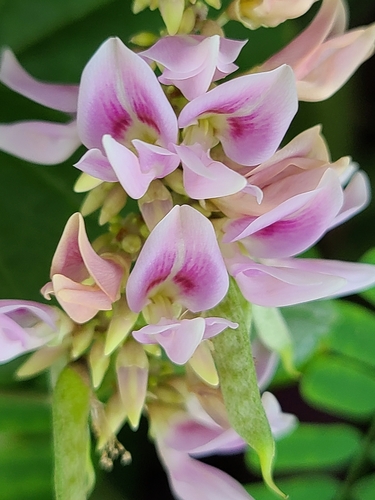
Hoffmannseggia glauca
(Ortega) Eifert
Indian rushpea

(c) Jerry Oldenettel, some rights reserved (CC BY-NC-SA)

no rights reserved
What to Eat
Edible parts: Tubers, Roots
The tubers and roots are roasted and eaten.
Where to Find It
It is a subtropical plant. In Argentina it grows from sea level to 4,000 m above sea level.
Argentina, Bolivia, Central America, Chile, Mexico, North America, Peru, South America, USA,
How to Identify
A herb. It keeps growing from year to year. It grows 5-30 cm tall. The leaves are 2-15 cm long. There are 2-6 pairs of leaflets with 4-12 leaflets on each one. They are narrowly oval and 2-11 mm long by 1-4 mm wide. The pods are curved and 3-4 cm long. There are 8-10 seeds. They are 3 mm long by 3 mm wide.
Wikipedia
Source ↗Hoffmannseggia glauca is a dicot found in the legume family, Fabaceae. Its common names include Indian rushpea, hog potato, and pig nut. It is a California native that prefers alkaline desert flats, creosote bush communities, and disturbed areas. It prefers elevations of less than 900 metres (3,000 ft). Hoffmannseggia glauca is found outside California in Western Nevada, Texas, Mexico, and South America. In California, H. glauca may be found in the San Joaquin Valley, the Southern Coastal Ranges, and the Western Transverse Ranges.
Notes
Also as Caesalpinaceae.
Names & Synonyms
Algarrobilla fina, Camincha, Papa cuchi, Culchao, Porotillo
References (13)
- Hedrick, U.P., 1919, (Ed.), Sturtevant's edible plants of the world. p 347 (As Hoffmannseggia stricta)
- Beckstrom-Sternberg, Stephen M., and James A. Duke. "The Foodplant Database." http://probe.nalusda.gov:8300/cgi-bin/browse/foodplantdb.(ACEDB version 4.0 - data version July 1994) (As Hoffmannseggia densiflora) (Also as Hoffmannseggia falcaria)
- Cordero, S. E., Abello, L. A., & Galvez, F. L., 2017, Plantas silvestres comestibles y medicinales de Chile y otras partes del mundo. CORMA p 184
- https://www.fireflyforest.com/flowers/category/edible-plants/ Edible Plants – Southeastern Arizona Wildflowers and Plants
- Icon. 4(2):63, t. 392. 1798 (As Hoffmannseggia falcaria)
- Illustrated Flora of Central Texas p 663
- Kermath, B. M., et al, 2014, Food Plants in the Americas: A survey of the domesticated, cultivated and wild plants used for Human food in North, Central and South America and the Caribbean. On line draft. p 421
- Leon-Lobos, P., et al, 2022, Patterns of Traditional and Modern Uses of Wild Edible Native Plants of Chile: Challenges and Future Perspectives. Plants (Basel) v 11 (6) Table S1
- Malezas Comestibles del Cono Sur, INTA, 2009, Buernos Aires
- Moerman, D. F., 2010, Native American Ethnobotany. Timber Press. p 267
- Plants for a Future database, The Field, Penpol, Lostwithiel, Cornwall, PL22 0NG, UK. http://www.scs.leeds.ac.uk/pfaf/ (As Hoffmannseggia densiflora)
- Pl. wright. 1:55. 1852 (Smithsonian Contr. Knowl. 3, Art. 5) (As Hoffmannseggia densiflora)
- World Checklist of Useful Plant Species 2020. Royal Botanic Gardens, Kew