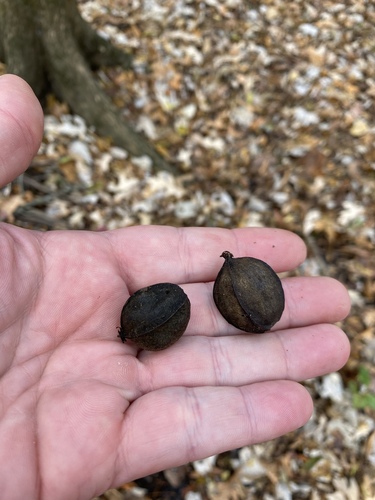
Carya glabra subsp. megacarpa
(Sarg.) Sarg.
Coastal pignut hickory

Botanical Research Institute of Texas

Duke University Vascular Plant Collection (DUKE-)

Duke University Vascular Plant Collection (DUKE-)
What to Eat
Edible parts: Seeds, Sap, Nuts
Where to Find It
It is a temperate plant.
North America, USA,
How to Identify
A temperate hickory tree of the Juglandaceae family with edible nuts and seeds.
Wikipedia
Source ↗Carya glabra, the pignut hickory, is a common, but not abundant species of hickory in the oak-hickory forest association in the Eastern United States and Canada. Other common names are pignut, sweet pignut, coast pignut hickory, smoothbark hickory, swamp hickory, and broom hickory. The pear-shaped nut ripens in September and October, has a sweet maple like smell, and is an important part of the diet of many wild animals. The wood is used for a variety of products, including fuel for home heating. It has pinnately compound leaves that turn a golden yellow in the fall.
Notes
There are about 14-25 Carya species.
References (1)
- Plants for a Future database, The Field, Penpol, Lostwithiel, Cornwall, PL22 0NG, UK. http://www.scs.leeds.ac.uk/pfaf/
More from Juglandaceae