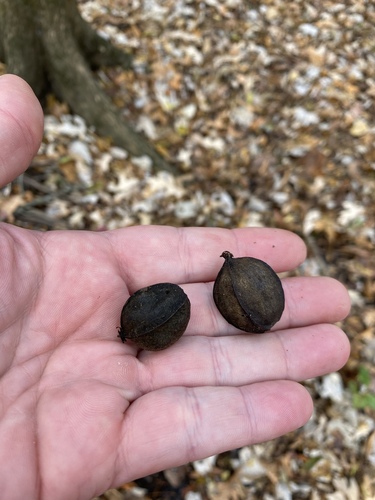
Carya laciniosa
(F. Michx.) G. Don
Big Shellbark hickory, Kingnut Hickory

(c) Dan Mullen, some rights reserved (CC BY-NC-ND)
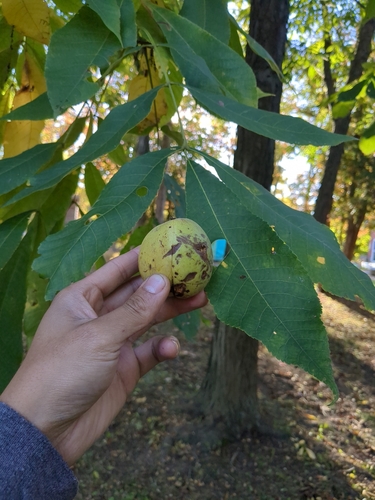
(c) treelogical, some rights reserved (CC BY-NC)
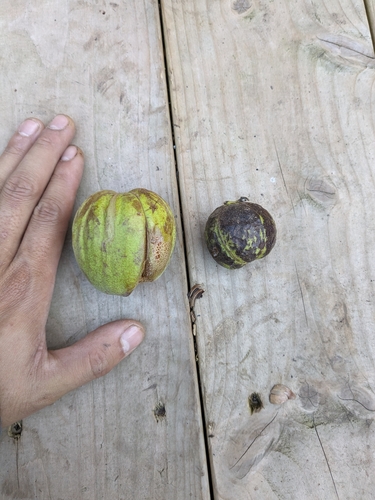
(c) treelogical, some rights reserved (CC BY-NC)
What to Eat
Edible parts: Nuts, Seeds, Sap
The seed can be eaten raw or cooked in pies, cakes, and similar preparations. It is sweet with a very fine flavour and is considered probably the finest-tasting of all the hickories. It produces the largest seeds in the genus, up to 5cm long, though the shell is hard and thick and cracking quality is poor compared to Carya ovata. Seeds ripen in late autumn and keep for at least 6 months when stored in the shell in a cool place. The sap has a sweet flavour and can be tapped in spring, then boiled down into a syrup or sugar for use in the same ways as maple syrup.
Where to Find It
They grow in rich, moist to wet soils in valleys and along stream banks. It suits hardiness zones 4-9.
Asia, Australia, Britain, Canada, Europe, India, North America, Northeastern India, USA,
How to Identify
A medium sized tree. It grows to 30 m high. The trunk can be 90 cm across. The trunk does not have branches for more than half its length. The trunk often tapers from the base up. The crown is often open with branches spreading out towards the top. The bark peels in 1 m long curving plates. The leaves have 7 or sometimes 9 leaflets. The leaves are 25-30 cm long. The leaflets are widest near the middle. The upper surface is dark yellowish-green. They are paler and hairy underneath. The central leaf stalk often remains after the leaflets have fallen. The male and female flowers are separate. The male or pollen flowers are in dense clusters of catkins. They occur at the base of new shoots. The female or seed flowers are in small clusters at the tips of new shoots. The fruit are almost round and 5-7 cm long. The husks are 6-12 mm thick and woody. They split along 4 lines to the base when ripe. The nuts have thicker shells with poorer cracking quality than Shagbark hickory. The kernels are sweet and edible.
Nutrition Score: 69/100
| Part | Moisture | kJ | kcal | Protein | Vit A | Vit C | Iron | Zinc |
|---|---|---|---|---|---|---|---|---|
| spp. Nuts | 2.7 | 2749 | 658 | 12.7 | 13 | 2 | 2.1 | 4.3 |
| Sap | — | — | — | — | — | — | — | — |
How to Grow
Propagation: Seed requires cold stratification before it will germinate. Sow in a cold frame as soon as seed is ripe; stored seed should be kept moist (but not wet) and sown in a cold frame as soon as possible. Where possible, sow 1 or 2 seeds per deep pot and thin to the strongest seedling. Transplant seedlings as soon as they are large enough to handle, using deep pots to accommodate the taproot, and move plants to their permanent positions as soon as possible — ideally in their first summer — with cold protection for at least the first winter. Seed can also be sown in situ with protection from mice and cold; a bottomless plastic bottle capped with wire mesh works well for both purposes.
Medicinal Uses
The inner bark is astringent and detergent. It has been used as a dressing for cuts and has been chewed to treat sore mouths.
Other Uses
The wood is close-grained, tough, hard, heavy, elastic, and very flexible, weighing 50 lb per cubic foot. It is an excellent wood used for tool handles, baskets, and fuel. The tree acts as a dynamic accumulator, gathering minerals and nutrients from the soil and storing them in a more bioavailable form suitable for use as fertilizer or mulch improvement.
Wikipedia
Source ↗Carya laciniosa, the shellbark hickory, in the Juglandaceae or walnut family is also called kingnut, big, bottom, thick, or western shellbark, attesting to some of its characteristics. It is a slow-growing, long-lived tree, hard to transplant because of its long taproot, and subject to insect damage. The nuts, largest of all hickory nuts, are sweet and edible. Wildlife and people harvest most of them; those remaining produce seedling trees readily. The wood is hard, heavy, strong, and very flexible, making it a favored wood for tool handles. A specimen tree has been reported in Missouri with 117 cm (46 in) diameter at breast height, 36.9 m (121 ft 1 in) tall, and a spread of 22.6 m (74 ft 2 in).
Production
Trees can live for 200 years.
Notes
There are about 14-25 Carya species.
Names & Synonyms
Hnum-rueh
References (24)
- Beckstrom-Sternberg, Stephen M., and James A. Duke. "The Foodplant Database." http://probe.nalusda.gov:8300/cgi-bin/browse/foodplantdb.(ACEDB version 4.0 - data version July 1994) (As Hicoria laciniosa)
- Bircher, A. G. & Bircher, W. H., 2000, Encyclopedia of Fruit Trees and Edible Flowering Plants in Egypt and the Subtropics. AUC Press. p 87
- Brouk, B., 1975, Plants Consumed by Man. Academic Press, London. p 221
- Cundall, P., (ed.), 2004, Gardening Australia: flora: the gardener's bible. ABC Books. p 335
- Duke, J.A., 1992, Handbook of Edible Weeds. CRC Press. p 62
- Elias, T.S. & Dykeman P.A., 1990, Edible Wild Plants. A North American Field guide. Sterling, New York p 243
- Etherington, K., & Imwold, D., (Eds), 2001, Botanica's Trees & Shrubs. The illustrated A-Z of over 8500 trees and shrubs. Random House, Australia. p 184
- Facciola, S., 1998, Cornucopia 2: a Source Book of Edible Plants. Kampong Publications, p 123
- Farrar, J.L., 1995, Trees of the Northern United States and Canada. Iowa State University press/Ames p 206
- Flowerdew, B., 2000, Complete Fruit Book. Kyle Cathie Ltd., London. p 194 (Also as Carya sulcata)
- Glowinski, L., 1999, The Complete Book of Fruit Growing in Australia. Lothian. p 106
- Gouldstone, S., 1978, Australian and New Zealand Guide to food bearing plants. Books for Pleasure. p 56
- Gouldstone, S., 1983, Growing your own Food-bearing Plants in Australia. Macmillan p 144
- Grandtner, M. M., 2008, World Dictionary of Trees. Wood and Forest Science Department. Laval University, Quebec, Qc Canada. (Internet database http://www.WDT.QC.ca)
- Hedrick, U.P., 1919, (Ed.), Sturtevant's edible plants of the world. p 171
- Jackes, D. A., Edible Forest Gardens
- Kar, A., et al, 2013, Wild Edible Plant Resources used by the Mizos of Mizoram, India. Kathmandu University Journal of Science, Engineering and Technology. Vol. 9, No. 1, July, 2013, 106-126
- Little, E.L., 1980, National Audubon Society Field Guide to North American Trees. Alfred A. Knopf. p 350
- J. C. Loudon, Hort. brit. ed. 1:384. 1830
- Lyle, S., 2006, Discovering fruit and nuts. Land Links. p 112
- Menninger, E.A., 1977, Edible Nuts of the World. Horticultural Books. Florida p 4
- Plants for a Future database, The Field, Penpol, Lostwithiel, Cornwall, PL22 0NG, UK. http://www.scs.leeds.ac.uk/pfaf/
- Tozer, F., 2007, The Uses of Wild Plants. Green Man Publishing. p 57
- Wickens, G.E., 1995, Edible Nuts. FAO Non-wood forest products. FAO, Rome. p 134
More from Juglandaceae