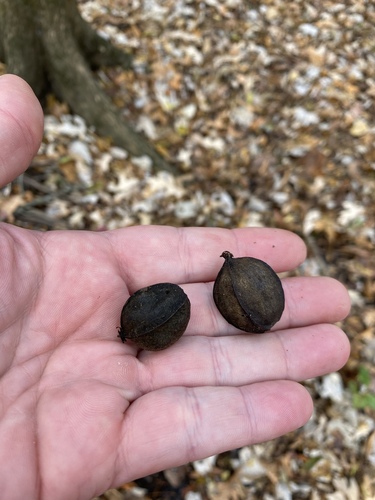
Carya pallida
(Ashe.) Engelm. & Graebn.
Sand hickory, Pale leaf hickory

(c) Douglas Goldman, some rights reserved (CC BY-SA), uploaded by Douglas Goldman

(c) Douglas Goldman, some rights reserved (CC BY-SA), uploaded by Douglas Goldman

(c) Douglas Goldman, some rights reserved (CC BY-SA), uploaded by Douglas Goldman
What to Eat
Edible parts: Seeds, Nuts
The seed can be eaten raw or cooked. It is small and sweet with a relatively thin shell, and measures up to 3cm long. Seeds ripen in late autumn and keep for at least 6 months when stored in the shell in a cool place.
Where to Find It
It grows on dry sandy and rocky soils. It grows to 760 m altitude in the USA. It suits hardiness zones 6-9.
Britain, Europe, North America, USA,
How to Identify
A large tree. It grows 24 m high. The trunk is 30-60 cm across. The bark is smooth and has deep grooves. The leaves are compound and 18-38 cm long. The leaves have 7-9 leaflets along the stalk. They are light green above and have silver-grey scales underneath. The flowers are very small and greenish. The male flowers are in slender drooping catkins. There are 3 flowers hanging from one stalk. The female flowers occur singly at the tip of the same twig. The fruit is oval and 30 mm long. It splits at the base when ripe. The seed is edible.
How to Grow
Propagation: Seed requires cold stratification before it will germinate. Sow in a cold frame as soon as seed is ripe; stored seed should be kept moist (but not wet) and sown in a cold frame as soon as possible. Where possible, sow 1 or 2 seeds per deep pot and thin to the strongest seedling. Transplant seedlings as soon as they are large enough to handle, using deep pots to accommodate the taproot, and move plants to their permanent positions as soon as possible — ideally in their first summer — with cold protection for at least the first winter. Seed can also be sown in situ with protection from mice and cold; a bottomless plastic bottle capped with wire mesh works well for both purposes.
Medicinal Uses
The inner bark is astringent and detergent. It has been used as a dressing for cuts and has been chewed to treat sore mouths.
Other Uses
The wood is heavy, hard, and tough, and is used for tool handles and similar applications. It makes a good fuel, burning well and giving off good heat.
Wikipedia
Source ↗Carya pallida, sand hickory, or pale hickory is a species of hickory native to the southeastern United States. It is a perennial, dicotyledonous plant which prefers rocky or sandy habitats. The sand hickory can reach heights of up to 30m, but its typical height is between 9-24m. In an open area, Carya crowns are usually towering and slim. The sand hickory nut is edible and consumed by various organisms.
Notes
There are about 14-25 Carya species.
Names & Synonyms
References (8)
- Bircher, A. G. & Bircher, W. H., 2000, Encyclopedia of Fruit Trees and Edible Flowering Plants in Egypt and the Subtropics. AUC Press. p 87
- H. G. A. Engler, Notizbl. Koenigl. Bot. Gart. Berlin App. 9:19. 1902
- Etherington, K., & Imwold, D., (Eds), 2001, Botanica's Trees & Shrubs. The illustrated A-Z of over 8500 trees and shrubs. Random House, Australia. p 185
- Krochmal, A. & Krochmal, C., 1982, Uncultivated Nuts of The United States. United States Department of Agriculture Forest Service. p 48
- Little, E.L., 1980, National Audubon Society Field Guide to North American Trees. Alfred A. Knopf. p 353
- Plants for a Future database, The Field, Penpol, Lostwithiel, Cornwall, PL22 0NG, UK. http://www.scs.leeds.ac.uk/pfaf/
- Tozer, F., 2007, The Uses of Wild Plants. Green Man Publishing. p 57
- Wickens, G.E., 1995, Edible Nuts. FAO Non-wood forest products. FAO, Rome. p 134
More from Juglandaceae