Carya texana
Buckley
Black hickory, Texas hickory, Buckley's hickory

(c) Douglas Goldman, some rights reserved (CC BY-SA), uploaded by Douglas Goldman

(c) Michael Gras, M.Ed., some rights reserved (CC BY)

(c) Douglas Goldman, some rights reserved (CC BY-SA), uploaded by Douglas Goldman
What to Eat
Edible parts: Seeds, Nuts
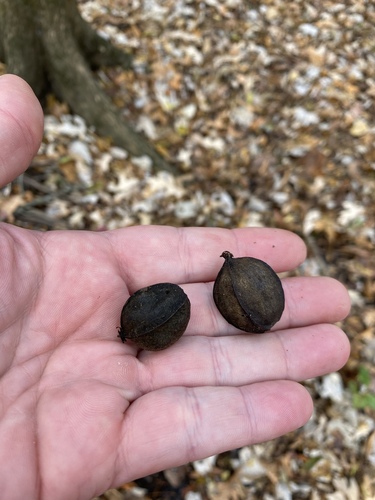
The seed can be eaten raw or cooked and generally has a sweet flavour, though one source describes the kernel as bitter. The seed is small with a very thick shell and measures up to 4cm long. Seeds ripen in late autumn and keep for at least 6 months when stored in the shell in a cool place.
Where to Find It
It is a temperate plant. It grows between 30 and 850 m altitude in the southern USA. It suits hardiness zones 6-9. It grows on dry sandy woods and rocky slopes.
Australia, North America, USA,
How to Identify
A tree. It grows 15 m high and spreads 8 m wide. The trunk is 30 cm across. The bark is furrowed and dark brown. The leaves are compound and 15-30 cm long. The leaves are mid green. They are made up of 7 sword shaped leaflets. The fruit is round. It splits at the base when ripe.
How to Grow
Prefers a deep moisture-retentive loam in a sunny sheltered position, requiring a good summer for best development. Slow growing. There is some confusion over the naming of this species, with two separate authors of the name being cited. C. texana. Buckl. is used by some authorities as the correct name and C. buckleyi (q.v.) is given as a synonym of that species. However, other authorities cite C. texana. DC. as the correct name, in this case C. buckleyi remains as a separate species. Plants are strongly tap-rooted and should be planted in their permanent positions as soon as possible. Sowing in situ would be the best method so long as the seed could be protected from mice. Trees are late coming into leaf (usually late May to June) and lose their leaves early in the autumn (usually in October). During this time they cast a heavy shade. These factors combine to make the trees eminently suitable for a mixed woodland planting with shrubs and other trees beneath them. Plants in this genus are notably resistant to honey fungus. Most species in this genus have quite a wide range of distribution and, in order to find trees more suited to this country, seed from the most appropriate provenances should be sought. Most trees growing in Britain at present tend to only produce good seed after hot summers. Trees are self-fertile but larger crops of better quality seeds are produced if cross-pollination takes place.
Propagation: Seed requires cold stratification before it will germinate. Sow in a cold frame as soon as seed is ripe; stored seed should be kept moist (but not wet) and sown in a cold frame as soon as possible. Where possible, sow 1 or 2 seeds per deep pot and thin to the strongest seedling. Transplant seedlings as soon as they are large enough to handle, using deep pots to accommodate the taproot, and move plants to their permanent positions as soon as possible — ideally in their first summer — with cold protection for at least the first winter. Seed can also be sown in situ with protection from mice and cold; a bottomless plastic bottle capped with wire mesh works well for both purposes.
Medicinal Uses
None known.
Other Uses
The wood is close-grained, tough, strong, and brittle, weighing 50 lb per cubic foot. It is used mainly as fuel, burning well and producing a great deal of heat.
Wikipedia
Source ↗Carya texana (called black hickory for its dark colored bark, or Texas hickory) is a North American tree in the walnut family, Juglandaceae. It is endemic to the United States, found primarily in the southern Great Plains and the Lower Mississippi Valley. It is an endangered species in Indiana, where it occurs in the southwest corner of the state.
Notes
There are about 14-25 Carya species.
Names & Synonyms
References (7)
- Bircher, A. G. & Bircher, W. H., 2000, Encyclopedia of Fruit Trees and Edible Flowering Plants in Egypt and the Subtropics. AUC Press. p 87 (As Carya arkansana)
- Cundall, P., (ed.), 2004, Gardening Australia: flora: the gardener's bible. ABC Books. p 335
- Krochmal, A. & Krochmal, C., 1982, Uncultivated Nuts of The United States. United States Department of Agriculture Forest Service. p 49
- Little, E.L., 1980, National Audubon Society Field Guide to North American Trees. Alfred A. Knopf. p 354
- Plants for a Future database, The Field, Penpol, Lostwithiel, Cornwall, PL22 0NG, UK. http://www.scs.leeds.ac.uk/pfaf/
- Proc. Acad. Nat. Sci. Philadelphia 12:444. 1861 ("1860")
- Wickens, G.E., 1995, Edible Nuts. FAO Non-wood forest products. FAO, Rome. p 134
More from Juglandaceae