Carya tonkinensis
H. Lecomte
Vietnam hickory

President and Fellows of Harvard College

Musum national d'histoire naturelle (France) (via Wikimedia Commons)
What to Eat
Edible parts: Nuts, Nuts-oil
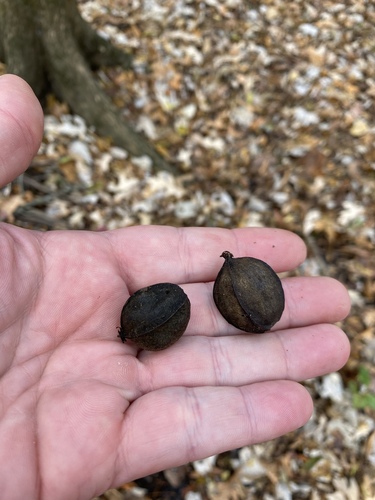
Seed - raw or cooked. The subglobose nuts are 22 - 25mm × 26 - 30mm. An edible oil can be pressed from the seeds. It is used for cooking.
Where to Find It
A tropical plant. It grows between 600 and 1,200 m altitude in N Vietnam. It needs good light. It requires fertile, moist, well drained soil. In China it grows between 1300-2200 m altitude.
Asia, China, India, Indochina, Laos, SE Asia, Vietnam,
How to Identify
A medium sized deciduous tree. It grow 20-25 m tall and has a trunk 50-60 cm across. The end buds are naked and brown. The leaves are 15-25 cm long. The leaf stalk is about 6 cm long. It is hairy. There are 5-7 leaflets. The blade is oval or sword shaped and 7-18 cm long by 2-6 cm wide. The base is unequal. It tapers to the tip. The male spike is 12-13 cm long. Its stalk is 1-5 cm long. The nuts are half round and 2.2-2.5 cm long by 2.6-3 cm wide. The husk does not have prominent wings. The shell has 4 faint ridges along it.
How to Grow
Carya tonkinensis is a plant mainly of subtropical regions.
Medicinal Uses
The bark is made into a tea and given to women after childbirth to contract the uterus and reduce bleeding.
Other Uses
An oil obtained from the seed can be used for lighting. The bark yields a brown dye. The sapwood is pinkish-grey, turning light brown on exposure, the heartwood is darker. Of medium texture with a slightly undulating grain, it is slightly lustrous, with no distinctive odour or taste. The wood is moderately hard, heavy and of good quality. It cuts easily and finishes smoothly. It is used for making furniture, in construction etc.
Wikipedia
Source ↗Carya tonkinensis, the Vietnam hickory, is a species of flowering plant in the genus Carya native to Assam in India, southern China, and northern Indochina. Local people harvest the wood for timber and furniture making, and collect the edible nuts for vegetable oil production.
Production
It is a fast growing tree.
Other Information
It could become a valuable fruit tree.
Notes
There are about 14-25 Carya species.
More from Juglandaceae