Dinetus racemosus
(Roxb.) Buch.-Ham. ex Sweet
Snow creeper

(c) 小铖/Smalltown, some rights reserved (CC BY-NC), uploaded by 小铖/Smalltown
(c) 綾蛾Actias, some rights reserved (CC BY-NC), uploaded by 綾蛾Actias

(c) Satish Nikam, some rights reserved (CC BY-NC-SA)
What to Eat
Edible parts: Leaves, Fruit stalks
The young leaves are eaten fresh or dried with pepper, and the fruit stalks are eaten when food is scarce.
Where to Find It
It is a tropical plant. It grows in open sites in forest and scrub. It grows between 1,000-2,000 m above sea level. In Sichuan and Yunnan.
Asia, Bhutan, China, East Timor, Himalayas, India, Indochina, Indonesia, Laos, Myanmar, Nepal, Pakistan, Papua New Guinea, PNG, Philippines, SE Asia, Thailand, Tibet, Timor-Leste, Vietnam, West Timor,
How to Identify
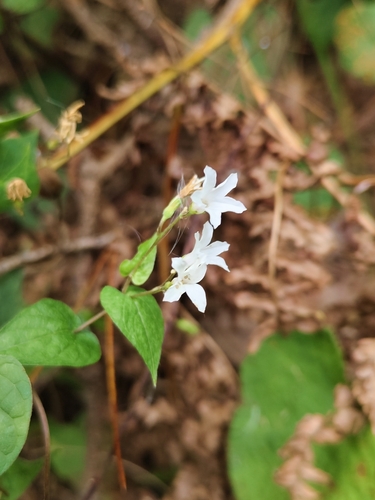
A twining herb. It usually grows 2-3 m long but can be much longer. The stems are angular and initially hairy. The leaf stalks are 3-7 cm long. The leaf blades are deeply heart shaped and 6-17 cm long by 4-9 cm wide. It is paler and hairy underneath. The flowering stalks occur singly or in pairs. They can be 13-45 cm long. The flowers are funnel shaped and usually white. The fruit is light brown and narrowly oval.
Names & Synonyms
Bai hua teng, Bhowri, Gariya, Ma-ywe
References (6)
- Ambasta, S.P. (Ed.), 2000, The Useful Plants of India. CSIR India. p 485 (As Porana racemosa)
- Burkill, I.H., 1966, A Dictionary of the Economic Products of the Malay Peninsula. Ministry of Agriculture and Cooperatives, Kuala Lumpur, Malaysia. Vol 2 (I-Z) p 1831 (As Porana racemosa)
- Fl. ind. 2:41. 1824 (As Porana racemosa)
- Simoes, A. R. et al, 2011, The Convolvulaceae of Timor with special reference to east Timor. Blumea 56:49-72
- Singh, H.B., Arora R.K.,1978, Wild edible Plants of India. Indian Council of Agricultural Research, New Delhi. p 40 (As Porana malabarica)
- WATT, (As Porana racemosa)


