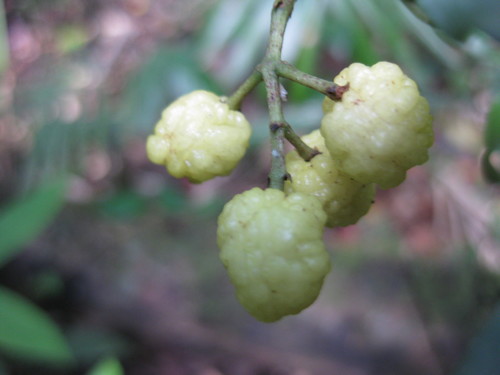
Zanthoxylum heterophyllum
Smith

(c) Andy Goerdel - Texas Master Naturalist, Good Water Chapter, some rights reserved (CC BY-NC)

(c) Andy Goerdel - Texas Master Naturalist, Good Water Chapter, some rights reserved (CC BY-NC)

(c) Andy Goerdel - Texas Master Naturalist, Good Water Chapter, some rights reserved (CC BY-NC)
What to Eat
Edible parts: Fruit, Bark - flavouring
The fruit and bark are used for flavouring.
Known Hazards
Where to Find It
It is a tropical plant. It grows in humid locations.
Africa, East Africa, Madagascar, Mauritius, Reunion,
How to Identify
A tree. The trunk can be 30-50 cm across. The leaves are compound with leaflets along the stalk and one at the end. The young leaves can have 30 pairs of leaflets. The older leaves have 3-6 pairs of leaflets. The leaflets are narrowly oval and wedge shaped at the base. Male and female flowers are separate. Male flowers are in groups of 100 flowers and females in groups of 60 flowers. They are yellow. The fruit are small and round or oval. They have a black seed.
Wikipedia
Source ↗Zanthoxylum heterophyllum is a species of plant in the family Rutaceae. It is found in Mauritius and Réunion. It is threatened by habitat loss. A large tree reaching 30 to 50 cm in diameter, the timber was formerly used for house construction. The International Union for Conservation of Nature has listed it as critically endangered since 1998. This species also occurred in Rodrigues, where it had been eradicated. In Mauritius, in 2013, less than 40 individuals were known in the wild. Schmelzer and Gurib-Fakim record that Zanthoxylum heterophyllum, known as bois de poivre (pepper wood), in reference to the taste of the fruit and/or its peppercorn appearance, was a medicinal plant in Réunion. The stem bark decoction was a sudorific, purgative, tonic and stomachic, to treat rheumatism, kidney pain, dysentery and toothache. For the latter ash of the stem bark relieved pain, and tea of the leaves, which are distinctly different between young and adult plants, was taken to increase milk flow of nursing mothers, and was externally applied to skin irritations.
Notes
It is a species at risk.
Names & Synonyms
References (1)
- Martin, F. W., et al, 1987, Perennial Edible Fruits of the Tropics. USDA Handbook 642 p 78