Cereus repandus
(L.) Mill.
Giant club Cactus
(c) Eric Knight, some rights reserved (CC BY), uploaded by Eric Knight
(c) James C. Davis, some rights reserved (CC BY-SA)
What to Eat
Edible parts: Fruit
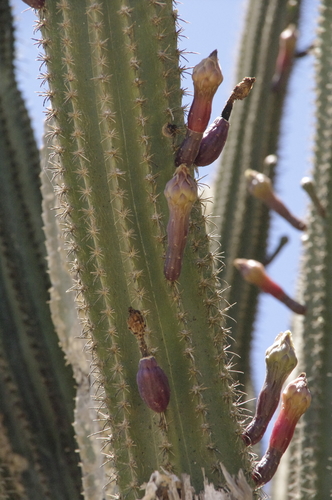
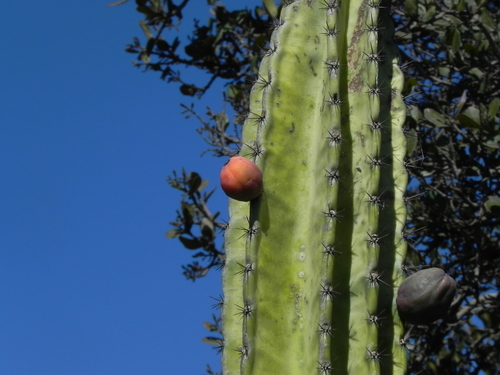
The fruit is eaten raw. Its white flesh has a mild, sweet flavour. The dark red (occasionally white), oblong fruit measures 3–4cm long and often splits open while still on the plant.
Where to Find It
It is a tropical plant. It grows in drier areas. It can tolerate very high temperatures. It may be able to tolerate light frosts. It needs a sunny position and well-drained soil. It suits acid soils. It needs bright light and a temperature above 10°C. It is drought tolerant. Hobart Botanical Gardens. Melbourne Botanical Gardens. Adelaide Botanical Gardens.
Africa, Antilles, Argentina, Aruba, Asia, Australia, Brazil, Caribbean, Central America, Colombia, Curacao, East Africa, Europe, France, Guianas, Hawaii, Indochina, Indonesia, Israel, Mediterranean, Mexico, Middle East, Netherlands Antilles, North America, Pacific, Peru, SE Asia, Slovenia, South America, Tasmania, Uruguay, USA, Venezuela, Vietnam, West Indies,
How to Identify
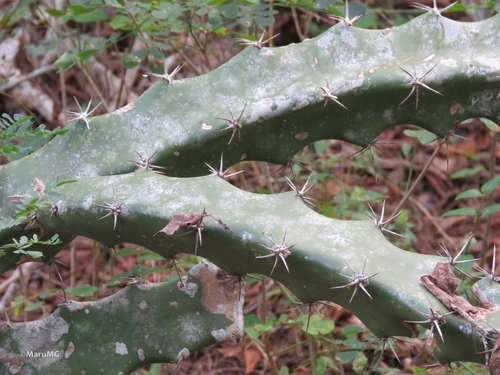
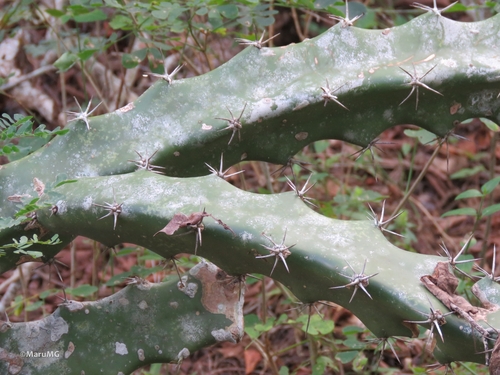
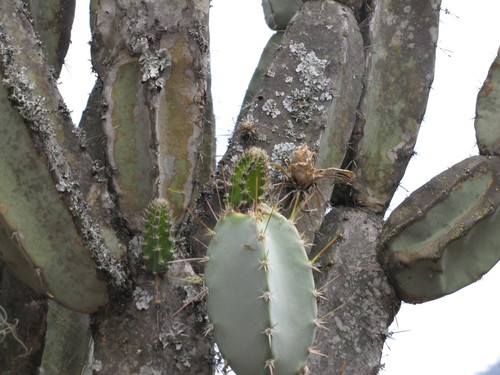
A tall cactus. It grows 3-5 m tall. It is like a low branching tree with columns. It can grow 16 m tall, but is often lower and 3-5 m high. The columns are 10-25 cm thick. They are dull green or bluish. There are 5-8 ribs and the furrows are deep. The spines are brown and 2 cm apart. There are 4-7 spines spreading out and a reddish brown central one. The side ones are 1 cm long and the central one is 2 cm long. The flowers appear at night. They are white with greenish-brown outer petals. They are 16 cm long. The fruit are apple sized, yellow and covered with spines. The spines brush off when the fruit is fully ripe.
How to Grow
Plants can be grown from seed or cuttings. They are planted in widely spaced rows. It can be used as a hedge.
Propagation: Seed.
Medicinal Uses
None known
Other Uses
The plant can be used for erosion control, as a hedge, or for ornamental purposes, and its fruits provide food for both humans and wildlife. It grows well in pots. Cereus repandus is largely unresearched and under-utilized, grown mostly as an ornamental. Its large, fragrant flowers are rich in nectar and pollen, attracting nocturnal pollinators such as moths. The cactus structure can provide shelter for wildlife and invertebrates, and leaf litter around the plant serves as habitat for beneficial insects. The flowers are not known to confuse pests. Suited to carbon farming and food forest use.
Wikipedia
Source ↗Cereus repandus (syn. Cereus peruvianus), the Peruvian apple cactus, is a large, erect, spiny columnar cactus found in South America. It is also known as giant club cactus, hedge cactus, cadushi (in Papiamento and Wayuunaiki), and kayush. Cereus repandus is grown mostly as an ornamental plant, but has some local culinary importance. The Wayuu from the La Guajira Peninsula of Colombia and Venezuela also use the inner cane-like wood of the plant in wattle and daub construction.
Production
Fruit are harvested when fully ripe.
Other Information
It is becoming a popular commercial fruit.
Names & Synonyms
Cactus apple, Cadushi, Cardon higo, Hedge cactus, Incataya, Kadushi, Kaktus apel, Koubo, Long cot, Noc tru, Perujski stebričar, Peruvian Apple cactus, Pitahaya, Pitayas, Tampana, Xuong rong khe
References (25)
- Anderson, E.F., 2001, The Cactus Family, Timber Press. p 148 (As Cereus peruvianus)
- Blamey, M and Grey-Wilson, C., 2005, Wild flowers of the Mediterranean. A & C Black London. p 149 (As Cereus uruguayanus)
- Bodkin, F., 1991, Encyclopedia Botanica. Cornstalk publishing, p 241 (As Cereus peruvianus)
- Darley, J.J., 1993, Know and Enjoy Tropical Fruit. P & S Publishers. p 17 (As Cereus peruvianus)
- Dharani, N., 2002, Field Guide to common Trees & Shrubs of East Africa. Struik. p 70 (As Cereus peruvianus)
- Facciola, S., 1998, Cornucopia 2: a Source Book of Edible Plants. Kampong Publications, p 63 (As Cereus peruvianus)
- Fern, K., 2012, Tropical Species Database http://theferns.info/tropical/
- Fouqué, A. 1972. Espèces fruitières d'Amérique tropicale. Institut français de recherches fruitierès outre-me (As Cereus peruvianus)
- Gard. dict. ed. 8: Cereus no. 4. 1768 (As Cereus peruvianus)
- Hibbert, M., 2002, The Aussie Plant Finder 2002, Florilegium. p 64 (As Cereus peruvianus)
- Innes, C. and Glass, C., 1997, The Illustrated Encyclopedia of Cacti. Sandstone Books. p 41 (As Cereus peruvianus)
- Kermath, B. M., et al, 2014, Food Plants in the Americas: A survey of the domesticated, cultivated and wild plants used for Human food in North, Central and South America and the Caribbean. On line draft. p 209
- Kiple, K.F. & Ornelas, K.C., (eds), 2000, The Cambridge World History of Food. CUP p 1742 (As Cereus peruvianus)
- Lopez-Diago, D. & Garcia, N., 2021, Wild edible fruits of Colombia. Biota ColomBiana 22 (2) p 34
- Lyle, S., 2006, Discovering fruit and nuts. Land Links. p 250 (As Cereus peruvianus)
- Martin, F. W., et al, 1987, Perennial Edible Fruits of the Tropics. USDA Handbook 642 p 86 (As Cereus margaritensis)
- Morton, Julia F., 1987, Fruits of Warm Climates. Creative Resources Systems, Inc. . p. 348 (As Cereus peruvianus)
- Pham-Hoang Ho, 1999, An Illustrated Flora of Vietnam. Nha Xuat Ban Tre. p 721 (As Cereus peruvianus)
- Recher, P, 2001, Fruit Spirit Botanical Gardens Plant Index. www.nrg.com.au/~recher/ seedlist.html p 1 (As Cereus peruvianus)
- Roa, J. A. G. & Boada, D. S. G., 2018, Fundación para el Fortalecimiento de la Fruticultura y Plantas Alimenticias no Convencionales en Colombia.
- Sukarya, D. G., (Ed.) 2013, 3,500 Plant Species of the Botanic Gardens of Indonesia. LIPI p 1007 (Also as Cereus peruvianus)
- Tanaka, Y. & Van Ke, N., 2007, Edible Wild Plants of Vietnam: The bountiful garden. Orchid books. p 62 (As Cereus peruvianus)
- van Wyk, B., 2005, Food Plants of the World. An illustrated guide. Timber press. p 127 (As Cereus peruvianus)
- World Checklist of Useful Plant Species 2020. Royal Botanic Gardens, Kew
- www.tradewindsfruit.com