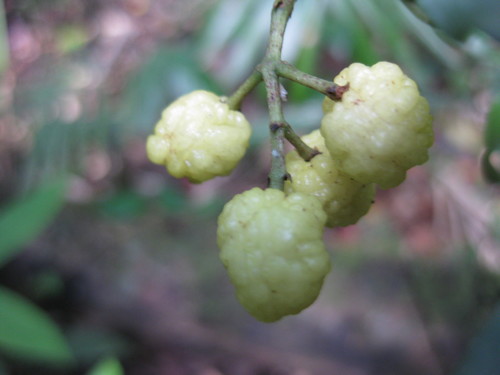
Vepris lanceolata
(Lam.) G. Don
White ironwood

(c) Adriaan Grobler, some rights reserved (CC BY-NC), uploaded by Adriaan Grobler

(c) Troos van der Merwe, some rights reserved (CC BY-NC)

(c) Miguel A. Casado, some rights reserved (CC BY-NC), uploaded by Miguel A. Casado
What to Eat
Edible parts: Fruit - spice
The fruit is used as a spice, serving as a substitute for cubebs.
Where to Find It
It is a subtropical plant. Melbourne Botanical garden.
Africa, Australia, East Africa, Mozambique, South Africa, Southern Africa,
How to Identify
A subtropical tree in the Rutaceae family found in Melbourne Botanical garden and other locations.
How to Grow
A tree of mainly lowland areas in the tropics and subtropics. Plants can tolerate some frosts. Established plants can tolerate occasional droughts, but dislike growing in very dry areas. The crushed leaves have a lemony scent. The plant responds well to pruning and responds moderately well to coppicing. A dioecious species, both male and female forms need to be grown if fruits and seed are required.
Propagation: Seed - best sown as soon as it is ripe. Seedlings transplant well.
Medicinal Uses
The plant is aromatic, astringent, bitter, febrifuge, stimulant and tonic. Leaf and root decoctions are used to treat malaria; however, high doses may result in peptic ulcers. The roots are used to treat infertility in women, menorrhagia, cardiac pain, colic and influenza. Root and stem decoctions are used as an anodyne for women during child delivery. The leaves are astringent. They are used in the treatment of pulmonary infections, rheumatic pains, fever, influenza, stomach-ache and amenorrhoea The pulverized leaves are applied externally as a poultice to relieve headaches. Leaf decoctions and infusions are used to wash wounds and sores. The leaves and branches contain alkaloids and limonoids. Leaf and root bark extracts have shown moderate in-vitro antiplasmodial activity. Aqueous leaf and stem extracts have shown moderate antibacterial and antifungal activities.
Other Uses
The heartwood is white to pale greenish brown; indistinctly demarcated from the up to 12.5cm wide sapwood. The grain is usually straight, texture fine and even. The wood is fairly heavy to very heavy, hard, tough, elastic but not durable. It is rather difficult to saw because of its hardness; it is recommended that it is sawn before drying. It works and planes readily, and can be finished to a smooth surface. The gluing and turning properties are satisfactory. The wood is used for beams, tool handles and implements. It is suitable for heavy construction, flooring, shipbuilding, vehicle bodies, furniture, cabinet work, mine props, sporting goods, toys, novelties, precision equipment, carving, vats and turnery. A reasonably fast-growing tree, it is planted to restore degraded environments. The tree does not have an aggressive root system.
Wikipedia
Source ↗Vepris lanceolata (umZane or white ironwood) is a large, evergreen tree native to southern and eastern Africa. It ranges from southeastern Kenya through Tanzania and Mozambique to South Africa, where it grows in coastal evergreen thicket or on loose sandy soil near beaches from sea level to 30 meters elevation.
References (1)
- Schmidt, E., Lotter, M., & McCleland, W., 2007, Trees and shrubs of Mpumalanga and Kruger National Park. Jacana Media p 236