Senna alata
(L.) Roxb.
Candle Bush, Ringworm Senna
(c) Cheongweei Gan, some rights reserved (CC BY-NC), uploaded by Cheongweei Gan

(c) elawrey, some rights reserved (CC BY)

(c) elawrey, some rights reserved (CC BY)
What to Eat
Edible parts: Leaves, Seeds, Seeds - coffee, Flowers
Young leaves are edible when cooked, and toasted leaves are sometimes used as a coffee substitute. Young pods are cooked and eaten as a vegetable, though only in small amounts.
Known Hazards
Where to Find It
A tropical plant. It prefers light to medium soils. It grows best in an open sunny position. It is drought and frost tender. It grows in rainforests and near swamps. It suits humid locations. It grows from 5 m to 360 m altitude in Papua New Guinea. In some countries it has been recorded up to 2,100 m above sea level. In Argentina it grows from sea level to 1,000 m above sea level. In Yunnan.
Africa, Amazon, American Samoa, Angola, Argentina, Asia, Australia, Benin, Bolivia, Brazil, Central Africa, Central America*, Cambodia, China, Colombia, Congo DR, Cuba, Dominican Republic, East Africa, Gabon, Ghana, Grenada, Guiana, Guianas, Guinea, Guinée, Guinea-Bissau, Guyana, Haiti, India, Indochina, Indonesia, Jamaica, Lesser Antilles, Madagascar, Malawi, Malaysia, Maldives, Mali, Marquesas, Mexico, Micronesia, Myanmar, Nauru, Nicaragua, Niue, North America, Northeastern India, Pacific, Palau, Papua New Guinea, PNG, Paraguay, Puerto Rico, Rotuma, Samoa, Sao Tome and Principe, SE Asia, Sierra Leone, South America, Sri Lanka, St Lucia, Suriname, Thailand, USA, Venezuela, Vietnam, West Africa, West Indies*,
How to Identify
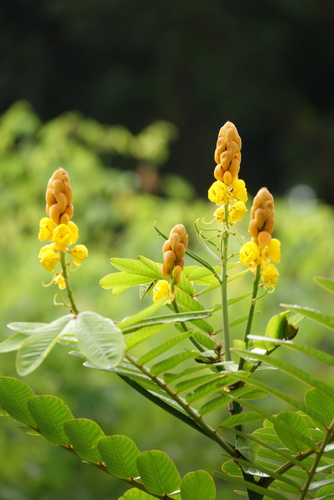
A shrub which loses its leaves during the year. It grows to 1-6 m high and spreads to 2 m across. The stem is erect and slender. The young stems are finely hairy. The leaves are large and oblong. They are divided into 8-14 pairs of leaflets. These are oblong and 5-19 cm long by 2.5-12 cm wide. They are usually blunt at the top. The flowers are yellow. They occur in spike-like clusters. These are 15-70 cm long. The fruit are winged pods. They are black and 12-17 cm long, with the central part 1.5-2 cm wide. The pod has partitions across it. The edge of the wing is wavy. The seeds are oval with a beak. They are 6-8 mm long and 4-5 mm wide. There are 2 shiny green patches near the beak.
How to Grow
Plants can be grown from seed.
Propagation: Seed requires pre-treatment to soften the hard seedcoat and allow water uptake. Soak the seed in a small amount of nearly boiling water (which cools quickly and does not cook the seed), then soak in warm water for 12–24 hours. Alternatively, carefully abrade a small area of the seedcoat without damaging the embryo. Can also be propagated by cuttings.
Medicinal Uses
Ringworm bush is widely used in traditional medicine, particularly valued for its laxative effect and its treatment of skin conditions including ringworm and scabies — uses supported by research. Anthraquinone derivatives isolated from the leaves include aloe-emodin, chrysophanol, isochrysophanol, and rhein, along with the alkaloid tyramine and the steroid beta-sitosterol. Crude leaf extracts show antibacterial activity against a range of bacteria (including Dermatophilus congolensis, which causes serious skin disease in cattle), antifungal properties (including against Pityriasis versicolor in humans), and antitumour activity. The bark contains tannins. The petals contain anthraquinones, glycosides, steroids, tannins, and volatile oil, and petal extracts show bactericidal activity against gram-positive but not gram-negative bacteria. Overall, the plant is laxative, antibacterial, antitumour, anti-inflammatory, diuretic, analgesic, vulnerary, weakly antifungal, hypoglycaemic, and antispasmodic. The leaves are laxative, taken internally for constipation and blood purification. Decocted leaves — with or without Tripogandra serrulata and Persea americana — treat biliousness and hypertension. Leaves are widely used for skin diseases, applied as a tincture, poultice, oil-mixed powder, or raw sap, effectively treating scabies, ringworm, and other fungal skin infections. The bark treats skin diseases, diarrhoea, worms, parasitic skin diseases, scabies, and eczema. The root is laxative; an infusion treats diarrhoea, tympanites, uterus problems, and filaria worm expulsion, and the root is applied externally to sores and skin fungi. The flowers are laxative and vermifuge; an infusion treats spleen conditions, and a decoction with Zingiber officinale treats grippe and acts as an abortifacient. Flowers decocted with coconut milk are used as a laxative. A combined infusion of leaves, flowers, and fruit treats stomach problems. The seed is laxative and anthelmintic, cooked to remedy intestinal worms. The leaf contains the purgative anthraquinone and shows antimicrobial activity. The stem contains chrysophanol, emodin, rhein, and aloe-emodin. Leaf and fruit contain purgative anthracene derivatives of aloe-emodin and rhein.
Other Uses
The plant has insecticidal and parasiticidal properties. The bark is a source of tannins and is sometimes used as a colouring agent in tattooing.
Wikipedia
Source ↗Senna alata is an important medicinal tree, as well as an ornamental flowering plant in the subfamily Caesalpinioideae. It also known as emperor's candlesticks, candle bush, candelabra bush, Christmas candles, empress candle plant, ringworm shrub, Roman candle, or candletree. A remarkable species of Senna, it was sometimes separated in its own genus, Herpetica.
Other Information
It is not known if they are used for food in Papua New Guinea.
Notes
The leaves are used to treat ringworm. There are about 260 Senna species. It can be invasive. Also as Caesalpinaceae.
Names & Synonyms
Anjananjana, Baba chakoda, Bhumiari, Bhupadma, Christmas candle, Chum het tet, Chum het yai, Cortalinde, Donghet, Empress candle plant, Gelenggang, Hpak-lam-mon-long, Hindi-sana, Kabaka, Katepeng badak, Ketepeng cina, Ketepeng, Khirkak, La'au fai lafa, Ludanggan, Mezali-gyi, Mulamula, Nat-ki-sana, Nela-tangedu, Nelavarike, Nila vaka, Nila virai, Pwesay-mezali, Ranauraa, Sanna-makki, Shona-makhi, Sindjo-el, Son-pat
References (33)
- Achigan-Dako, E, et al (Eds), 2009, Catalogue of Traditional Vegetables in Benin. International Foundation for Science.
- Ambasta S.P. (Ed.), 2000, The Useful Plants of India. CSIR India. p 109 (As Cassia alata)
- Bodkin, F., 1991, Encyclopedia Botanica. Cornstalk publishing, p 220 (As Cassia alata)
- Borrell, O.W., 1989, An Annotated Checklist of the Flora of Kairiru Island, New Guinea. Marcellin College, Victoria Australia. p 93, 100+8 (As Cassia alata)
- Burkill, I.H., 1966, A Dictionary of the Economic Products of the Malay Peninsula. Ministry of Agriculture and Cooperatives, Kuala Lumpur, Malaysia. Vol 1 (A-H) p 479 (As Cassia alata)
- Catarino, L., et al, 2016, Ecological data in support of an analysis of Guinea-Bissau's medicinal flora. Data in Brief 7 (2016):1078-1097
- Cundall, P., (ed.), 2004, Gardening Australia: flora: the gardener's bible. ABC Books. p 1335
- Dharani, N., 2002, Field Guide to common Trees & Shrubs of East Africa. Struik. p 264
- Ekka, N. S. & Ekka, A., 2016, Wild Edible plants Used by Tribals of North-east Chhattisgarh (Part-I), India. Research Journal of Recent Sciences. Vol. 5(ISC-2015), 127-131 (2016) (As Cassia alata)
- Fl. ind. ed. 1832, 2:349. 1832
- Gardner, S., et al, 2000, A Field Guide to Forest Trees of Northern Thailand, Kobfai Publishing Project. p 172
- Grandtner, M. M. & Chevrette, J., 2013, Dictionary of Trees, Volume 2: South America: Nomenclature, Taxonomy and Ecology. Academic Press p 597
- Hall, N. et al, 1972, The Use of Trees and Shrubs in the Dry Country of Australia, AGPS, Canberra. p 208 (As Cassia alata)
- Henty, E.E., & Pritchard, G.S., 1973, Weeds of New Guinea and their control. Botany Bulletin No 7, Division of Botany, Lae, PNG. p 116 (As Cassia alata)
- Hibbert, M., 2002, The Aussie Plant Finder 2002, Florilegium. p 61 (As Cassia alata)
- Jardin, C., 1970, List of Foods Used In Africa, FAO Nutrition Information Document Series No 2.p 25 (As Cassia alata)
- Latham, P., 2004, Useful Plants of Bas-Congo province. Salvation Army & DFID p 70
- Lazarides, M. & Hince, B., 1993, Handbook of Economic Plants of Australia, CSIRO. p 50 (As Cassia alata)
- Marinelli, J. (Ed), 2004, Plant. DK. p 468
- Martin, F.W. & Ruberte, R.M., 1979, Edible Leaves of the Tropics. Antillian College Press, Mayaguez, Puerto Rico. p 48, 198 (As Cassia alata and Herpetica alata)
- Paczkowska, G. & Chapman, A.R., 2000, The Western Australian Flora. A Descriptive Catalogue. Western Australian Herbarium. p 190
- Peekel, P.G., 1984, (Translation E.E.Henty), Flora of the Bismarck Archipelago for Naturalists, Division of Botany, Lae, PNG. p 219, 220 (As Cassia alata)
- Pham-Hoang Ho, 1999, An Illustrated Flora of Vietnam. Nha Xuat Ban Tre. p 849 (As Cassia alata)
- Plants of Haiti Smithsonian Institute http://botany.si.edu/antilles/West Indies
- Roa, J. A. G. & Boada, D. S. G., 2018, Fundación para el Fortalecimiento de la Fruticultura y Plantas Alimenticias no Convencionales en Colombia.
- Sarma, H., et al, 2010, Updated Estimates of Wild Edible and Threatened Plants of Assam: A Meta-analysis. International Journal of Botany 6(4): 414-423 (As Cassia alata)
- Staples, G.W. and Herbst, D.R., 2005, A tropical Garden Flora. Bishop Museum Press, Honolulu, Hawaii. p 325
- Sujanapal, P., & Sankaran, K. V., 2016, Common Plants of Maldives. FAO & Kerala FRI, p 235
- Sukarya, D. G., (Ed.) 2013, 3,500 Plant Species of the Botanic Gardens of Indonesia. LIPI p 712
- Suksri, S., et al, 2005, Ethnobotany in Bung Khong Long Non-Hunting Area, Northeast Thailand. Kasetsart J., (Nat. Sci) 39: 519-533
- Terashima, H., et al, 1992, Ethnobotany of the Lega in the Tropical Rainforest of Eastern Zaire (Congo): Part Two, Zone de Walikale, African Study Monographs, Suppl. 19:1-60
- Turreira Garcia, N., et al, 2017, Ethnobotanical knowledgeof the Kuy and Khmer people in Prey Lang, Cambodia. Cambodian Journal of Natural History 2017 (1): 76-101 Verdcourt, B., 1979, Manual of New Guinea Legumes. Botany Bulletin No 11, Division of Botany, Lae, Papua New Guinea. p 38 (As Cassia alata)
- World Checklist of Useful Plant Species 2020. Royal Botanic Gardens, Kew