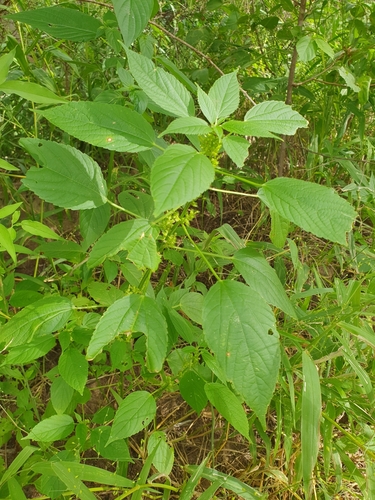
Suregada multiflora
(Juss.) Baill.
False lime shrub
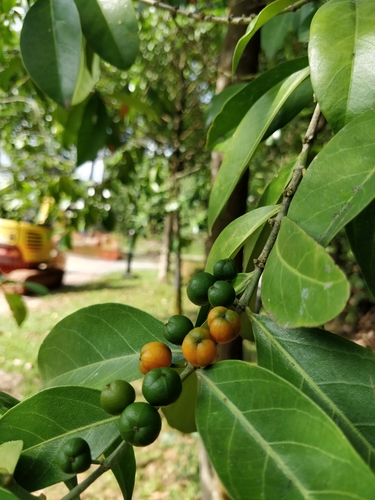
(c) ps_t, some rights reserved (CC BY-NC)
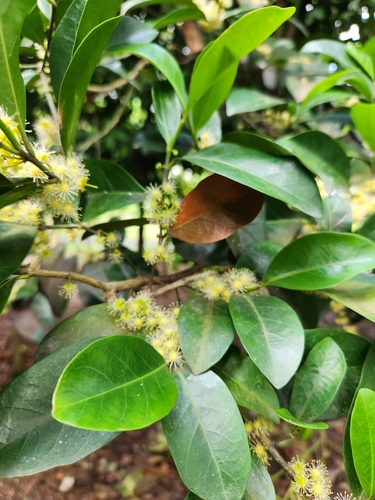
(c) Tan Jun Nian, some rights reserved (CC BY-NC)
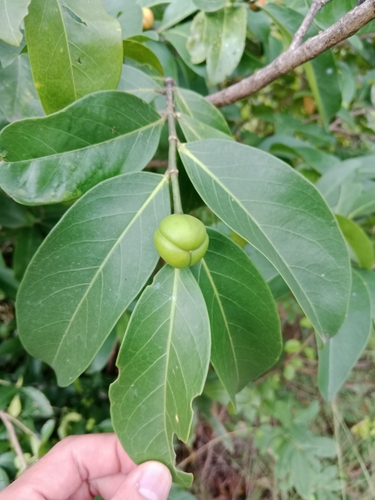
(c) ben-valentine, some rights reserved (CC BY-NC)
What to Eat
Edible parts: Fruit
The ripe fruit are eaten raw.
Where to Find It
It is a subtropical plant. In southern China it grows in the lowlands below 100-600 m above sea level. In Yunnan.
Asia, Bangladesh, Cambodia, China, India, Indochina, Indonesia, Laos, Malaysia, Myanmar, Northeastern India, SE Asia, Thailand, Vietnam,
How to Identify
A tree. The bark cracks along its length. The leaves are oval and smooth but with clear dots. The base of the leaf is wedge shaped. The flowers are yellowish and have a scent. The flowers are of separate sexes. The fruit is round and has 3 lobes. They are blackish when ripe. They are 11-15 mm across and have 3 seeds.
How to Grow
Plants are grown from seeds.
Wikipedia
Source ↗Suregada multiflora, sometimes called the "false lime tree", is a species in the family Euphorbiaceae. The Catalogue of Life lists no subspecies. It is found in tropical Asia: names include kén or mân mây in Viet Nam.
Production
In NE Thailand the fruit are available May to June.
Names & Synonyms
Ban naranga, Ban-naringa, Buah punai mengatok, Cheremai hutan, Duk sai, Ganari, Khakra, Khantang payabat, Markdaok, Mar-tu-kelok-arong, Midoumabaphang, Modouma biphang, Perdu limau hantu, Pindemaredu, Ruas-ruas, Suragata, Theng chek te, Theng chek-te, Yai pluak
References (11)
- Ambasta, S.P. (Ed.), 2000, The Useful Plants of India. CSIR India. p 233 (As Gelonium multiflorum)
- Burkill, I.H., 1966, A Dictionary of the Economic Products of the Malay Peninsula. Ministry of Agriculture and Cooperatives, Kuala Lumpur, Malaysia. Vol 1 (A-H) p 1082 (As Gelonium multiflorum)
- Euphorb. gen. 111, t. 10, fig. 31a. 1824 (As Gelonium multiflorum)
- Pasha, M. K. & Uddin, S. B., 2019, Minor Edible Fruits of Bangladesh. Bangladesh J. Plant Taxon. 26(2): 299–313
- Patiri, B. & Borah, A., 2007, Wild Edible Plants of Assam. Geethaki Publishers. p 130
- Pullaiah, T., et al, Ethnobotany of India, Volume 1: Eastern Ghats and Deccan.
- Singh, H.B., Arora R.K.,1978, Wild edible Plants of India. Indian Council of Agricultural Research, New Delhi. p 62 (As Gelonium multiflorum)
- Singh, V. B., et al, (Ed.) Horticulture for Sustainable Income and Environmental Protection. Vol. 1 p 217 (As Gelonium multiflorum)
- Sukarya, D. G., (Ed.) 2013, 3,500 Plant Species of the Botanic Gardens of Indonesia. LIPI p 720
- Suksri, S., et al, 2005, Ethnobotany in Bung Khong Long Non-Hunting Area, Northeast Thailand. Kasetsart J., (Nat. Sci) 39: 519-533
- Turreira Garcia, N., et al, 2017, Ethnobotanical knowledgeof the Kuy and Khmer people in Prey Lang, Cambodia. Cambodian Journal of Natural History 2017 (1): 76-101