Anodendron paniculatum
A. DC.
Andamese bowstring plant
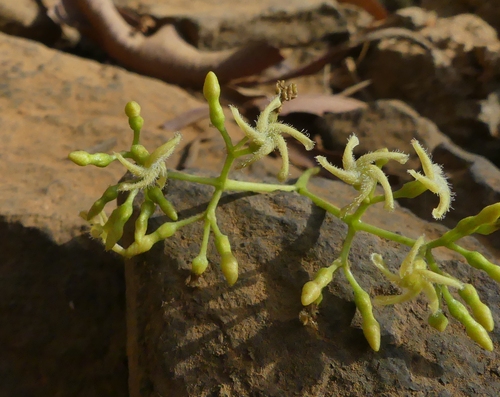
(c) Radha Veach, some rights reserved (CC BY-NC)
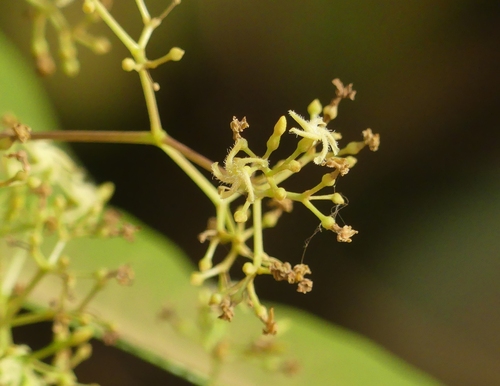
(c) Radha Veach, some rights reserved (CC BY-NC)
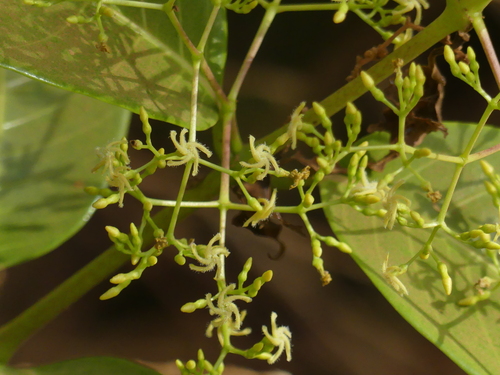
(c) Radha Veach, some rights reserved (CC BY-NC)
What to Eat
Edible parts: Fruit
The fruit are eaten.
Known Hazards
Where to Find It
It is a tropical plant. It grows in dry deciduous forests. It occurs in the Western Ghats in India.
Andamans, Asia, Bangladesh, Cambodia, India, Indochina, Indonesia, Malaysia, Myanmar, Northeastern India, Laos, Papua New Guinea, PNG, Philippines, SE Asia, Sri Lanka, Thailand, Vietnam,
How to Identify
A woody creeper. It grows 20 m long. The bark is brown. The leaf stalks are 3 cm long. The leaves are narrowly oval and 14-28 cm long by 1-10 cm wide. They are wedge shaped or rounded at the base. The flower panicles are 15 cm long. The flowers are small and tube shaped and white or yellow. They are in the axils of leaves or at the ends of branches. The fruit are large follicles in pairs. These can be 16 cm long by 3 cm wide. They are black when ripe. The seeds are small and flattened and 1-2 cm long by 6-8 mm wide. These have a silky tuft attached.
How to Grow
Plants can be grown from seeds.
Other Uses
A very strong, fine fibre is obtained from the bark. It is used for making nets. The fibre is highly esteemed locally. The sap of the plant is said to contain latex from which rubber can be made. However, in many areas the sap is completely without latex.
Production
In southern India it flowers and fruits February to October.
Names & Synonyms
Gambi, Kakkakodi, Liane parachute plant, Sarakkodi, Theikelki, Twin-net
References (2)
- Lalfakzuala, R., 2007, Ethnobotanical usages of plants in western Mizoram. Indian Journal of Traditional Knowledge. Vol 6(3) pp 480-493
- Sukarya, D. G., (Ed.) 2013, 3,500 Plant Species of the Botanic Gardens of Indonesia. LIPI p 895


