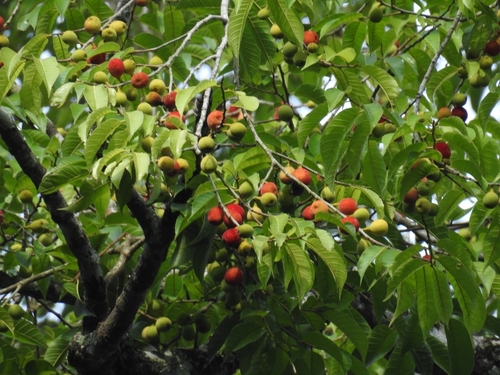
Ficus prostrata
(Wall. ex Miq.) Buch.-Ham. ex Miq.
MoraceaeFruit

gbif · cc0
GBIF
GBIF

gbif · cc-by
Royal Botanic Gardens, Kew
Royal Botanic Gardens, Kew

gbif · cc-by
Royal Botanic Gardens, Kew
Royal Botanic Gardens, Kew
What to Eat
Edible parts: Fruit
The fruit are eaten.
Where to Find It
It is a tropical plant. It grows in dense forests between 1,200-1,500 m above sea level. In Yunnan.
Asia, Bangladesh, China, Himalayas, India, Northeastern India, SE Asia, Sikkim, Vietnam,
Countries: United Arab Emirates, Afghanistan, Armenia, Azerbaijan, Bangladesh, Bahrain, Brunei, Bhutan, China, Georgia, Indonesia, Israel, India, Iraq, Iran, Jordan, Japan, Kyrgyzstan, Cambodia, North Korea, South Korea, Kuwait, Kazakhstan, Laos, Lebanon, Sri Lanka, Myanmar, Mongolia, Maldives, Malaysia, Nepal, Oman, Philippines, Pakistan, Qatar, Saudi Arabia, Singapore, Syria, Thailand, Tajikistan, Timor-Leste, Turkmenistan, Turkey, Taiwan, Uzbekistan, Vietnam, Yemen
How to Identify
A fig. It is a small tree. The leaves are alternate and oval to sword shaped. They are 8-11 cm long. The figs hang down. They are near ground level.
Names & Synonyms
Ping zhi rong, Theitit, Thotseno
Covellia prostrata Wallich ex Miquel
References (3)
- Chase, P. & Singh, O. P., 2016, Bioresources of Nagaland: A Case of Wild 4 Edible Fruits in Khonoma Village Forest. in J. Purkayastha (ed.), Bioprospecting of Indigenous Bioresources of North-East India. p 50
- Flora of China @ efloras.org Volume 5
- Lalfakzuala, R., 2007, Ethnobotanical usages of plants in western Mizoram. Indian Journal of Traditional Knowledge. Vol 6(3) pp 480-493