Adiantum caudatum
L.
Walking maidenhair, Trailing maidenhair
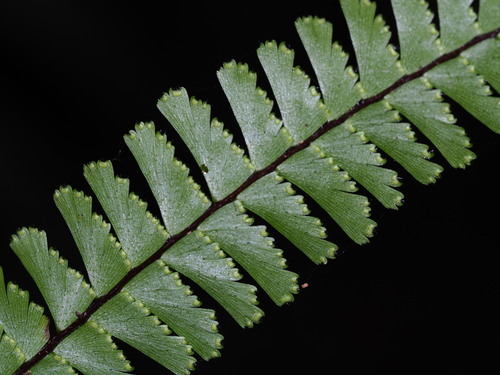
no rights reserved, uploaded by 葉子
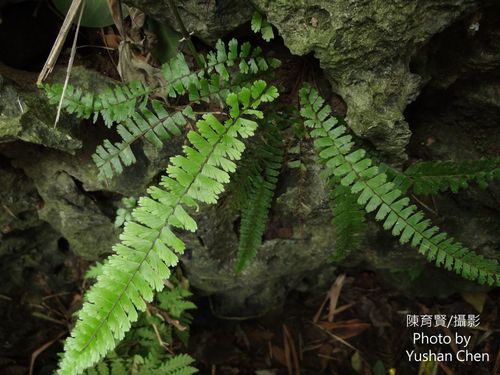
(c) 陳育賢, some rights reserved (CC BY-NC), uploaded by 陳育賢

(c) Keith Bradley, some rights reserved (CC BY-NC), uploaded by Keith Bradley
What to Eat
Edible parts: Fronds, Leaves
The fronds and leaves are edible.
Known Hazards
Where to Find It
It is a tropical plant. It grows on rocks and in rock crevices including limestone. In China it grows in forests and mountain valleys. It grows in shaded places. In Thailand it grows up to 1,000 m above sea level. It needs to be kept moist. It suits hardiness zone 9-11.
Africa, Asia, Bangladesh, Bhutan, Cambodia, China, Himalayas, India, Indochina, Indonesia, Laos, Madagascar, Malaysia, Myanmar, Nepal, Northeastern India, Pacific, Philippines, SE Asia, Sri Lanka, St. Kitts and Nevis, Taiwan, Thailand, Vietnam,
How to Identify
A fern. It grows 10-40 cm tall. It has a short erect rhizome covered with scales. The stalk from the rootstock to the leaf blade is 1-15 cm long. It has brown hairs. The leaves are narrow and have leaflets along the stalk. The leaves are 8-35 cm long by 2-4 cm wide and there are 20-44 pairs of leaflets. These become smaller towards the top.
How to Grow
It can be grown from plantlets on the tips of the fronds. It can be grown from spores, rhizomes or division of the clump.
Propagation: Spores. Division of new plants formed at the apex of the fronds.
Medicinal Uses
The fronds are said to be antiasthmatic, antispasmodic. They are used in the treatment of diabetes, coughs, fevers and migraine. The fronds are used externally to treat skin diseases.
Wikipedia
Source ↗Adiantum caudatum, commonly walking maidenhair, tailed maidenhair, trailing maidenhair is a fern in the genus Adiantum and the family Pteridaceae.
Notes
Also put in the family Adiantaceae.
Names & Synonyms
Chakawkria, Slender maiden hair, Suplir berekor, Voanjonala
References (3)
- Lalfakzuala, R., 2007, Ethnobotanical usages of plants in western Mizoram. Indian Journal of Traditional Knowledge. Vol 6(3) pp 480-493
- Sukarya, D. G., (Ed.) 2013, 3,500 Plant Species of the Botanic Gardens of Indonesia. LIPI p 851
- www.eFloras.org Flora of China


