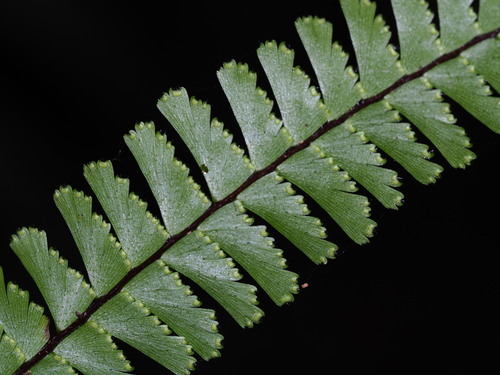
Adiantum capillus-veneris
L.
True Maidenhair fern

Wikimedia Commons - Arkadiusz Nowak, Marcin Nobis, Sylwia Nowak, Agnieszka Nobis, Anna Wróbel, Sebastian Świerszcz, Ewelina Klichowska, Iwona Dembicz & Grzegorz Kusza

Wikimedia Commons - cultivar413

(c) Jorge Leandro, some rights reserved (CC BY-NC), uploaded by Jorge Leandro
What to Eat
Edible parts: Fronds, Leaves - flavouring, Leaves - tea, Vegetable
Tea. The fronds are used as a garnish on sweet dishes. The dried fronds are used to make a tea[2, 106, 115, 177, 183]. A syrup is made from the plant, which makes a refreshing summer drink. The fern (does this refer to the rootstock?) is simmered in water for several hours, and the liquid is made into a thick syrup with sugar and orange water. It is then mixed with fruit juices to make a refreshing drink. Foraging: Venus maidenhair fern is not a food plant, but the aboveground fronds have been used traditionally for making beverages and flavorings. Tea: The fronds can be steeped to make a mild herbal tea. The flavor is light and refreshing, with faint grassy and hay-like notes. It is not strongly sweet or aromatic, but is valued for its smoothness and lack of harshness. Syrup/Flavoring: The tea can be concentrated by boiling down into a syrup, which was once used as a subtle flavoring in desserts and drinks. No other parts of the plant (roots, rhizomes, spores) are edible, and it was never used as a staple food.
Known Hazards
Where to Find It
It is a warm temperate to subtropical plant. It needs a well drained but moist soil. It likes plenty of light but not full sun. They only grow where frosts are rare. It suits warm temperate and subtropical regions but will grow in cooler regions. It needs temperatures above 7°C. In China it grows between 100-2,800 m above sea level. It grows in limestone soil. It suits hardiness zones 8-11.
Africa, Albania, Asia, Australia, Bangladesh, Botswana, Britain, Central America, Central Asia, China, East Africa, Egypt, Europe, Fiji, Himalayas, India, Indochina, Iraq, Ireland, Italy, Japan, Korea, Lesotho, Libya, Mediterranean, Mexico, Middle East, Mozambique, Nepal, North Africa, North America, Pacific, Rotuma, San Marino, Saudi Arabia, SE Asia, Southern Africa, Spain, Tajikistan, Tonga, Vietnam, Zambia, Zimbabwe,
How to Identify
A fern which grows to 30-60 cm high. The rhizome is short and creeping and thin. It spreads to 30 cm wide. The leaves are clustered. The fronds are divided 2-3 times. The frond blade is triangular. The fronds are light green. The stalk is blackish brown, shiny and hairless.
How to Grow
Spores can be sown on sterile humus rich soil. Keeping a plastic bag over the plants helps keep them moist. Spores germinate in about 6 weeks. Small plants need to be kept moist and transplanted. They need to be in a sheltered position. Plants can be grown by division of the clumps.
Propagation: Sow spores as soon as ripe on the surface of humus-rich sterilized soil, keeping moist under plastic cover. Germination occurs within 6 weeks. Pot small plantlets when large enough and maintain humidity until established. Do not plant outdoors until ferns are at least 2 years old in very sheltered positions. Divide in spring or autumn, preferably early spring.
Medicinal Uses
Historically the main ingredient in 'Capillaire' cough syrup. Fresh or dried fronds are antidandruff, antitussive, depurative, emmenagogue, expectorant, galactogogue, refrigerant, and tonic. Tea or syrup treats coughs, throat afflictions, and bronchitis. Used as a detoxicant in alcoholism and to expel parasitic worms. A poultice treats snake bites and bee stings. In Nepal, a paste applied to the forehead relieves headaches and to the chest relieves chest pain. Best used fresh, though summer-harvested fronds can be dried for later use.
Other Uses
Leaves serve as a hair tonic and treatment for dandruff.
Wikipedia
Source ↗Small fern growing slowly to 0.3 m with seeds ripening May to September. Hardy to UK zone 9 but frost tender. Suitable for light sandy to heavy clay soils with neutral to basic pH and good drainage. Tolerates semi-shade in light woodland and prefers consistently moist soil.
Notes
There are over 200 Adiantum species. This one is used for medicine in Nepal and Bangladesh. Also put in the family Adiantaceae.
Names & Synonyms
Adiantum, Capillaire, Common maidenhair, Dudder grass, Dumtuli, Hanspadi, Hansraj, Mubaraka, Pursha, Venus hair fern, Vilina vlas
References (32)
- Aiguo, C. & Zhiling, D., 2001, Managing Agricultural Resources for Biodiversity Conservation. Case Study Yunnan, Southwest China. Environment Liaison Center International. p 39
- Ambasta S.P. (Ed.), 2000, The Useful Plants of India. CSIR India. p 15
- Andrews, S.B., 1990, Ferns of Queensland. A handbook to the ferns and fern allies. Queensland DPI p 10
- Biocyclopedia Edible Plant Species. biocyclopedia.org
- Blamey, M and Grey-Wilson, C., 2005, Wild flowers of the Mediterranean. A & C Black London. p 531
- Bodkin, F., 1991, Encyclopedia Botanica. Cornstalk publishing, p 49
- Bremness, L., 1994, Herbs. Collins Eyewitness Handbooks. Harper Collins. p 286
- Brickell, C. (Ed.), 1999, The Royal Horticultural Society A-Z Encyclopedia of Garden Plants. Convent Garden Books. p 78
- Brown, D., 2002, The Royal Horticultural Society encyclopedia of Herbs and their uses. DK Books. p 103
- Chaffey, C.H., 1999, Australian Ferns. Growing them successfully. Kangaroo Press. p 75
- Checklist of NT Vascular Plant Species. January 2003.
- Cundall, P., (ed.), 2004, Gardening Australia: flora: the gardener's bible. ABC Books. p 99
- Facciola, S., 1998, Cornucopia 2: a Source Book of Edible Plants. Kampong Publications. p 2
- Hedrick, U.P., 1919, (Ed.), Sturtevant's edible plants of the world. p 26
- Irving, M., 2009, The Forager Handbook, A Guide to the Edible Plants of Britain. Ebury Press p 350
- Jardin, C., 1970, List of Foods Used In Africa, FAO Nutrition Information Document Series No 2.p 112
- Mabey, R., 1973, Food for Free. A Guide to the edible wild plants of Britain, Collins. p 120
- Manandhar, N.P., 2002, Plants and People of Nepal. Timber Press. Portland, Oregon. p 72
- Mahklouf, M. H., 2019, Ethnobotanical Study of Edible Wild Plants in Libya. European Journal of Ecology. 5(2): 30-40
- Marinelli, J. (Ed), 2004, Plant. DK. p 312
- Paczkowska, G . & Chapman, A.R., 2000, The Western Australian Flora. A Descriptive Catalogue. Western Australian Herbarium. p 21
- Pandy, R. K. & Saini, S. K., 2007, Edible plants of tropical forests among tribal communities of Madhya Pradesh. Indian Journal of Traditional Knowledge. 6(1), pp 185-190
- Pham-Hoang Ho, 1999, An Illustrated Flora of Vietnam. Nha Xuat Ban Tre. p 55
- Plants for a Future database, The Field, Penpol, Lostwithiel, Cornwall, PL22 0NG, UK. http://www.scs.leeds.ac.uk/pfaf/
- Redzic, S. J., 2006, Wild Edible Plants and their Traditional Use in the Human Nutrition in Bosnia-Herzegovina. Ecology of Food and Nutrition, 45:189-232
- Sarker, S. K., & Enayet Hossain, A. B. M., 2009, Pteridophytes of Greater Mymensingh District of Bangladesh used as Vegetables and Medicines. Bangladesh J. Plant Taxon. 16(1) 47-56. p 49
- Setshogo, M. P., 2005, Preliminary checklist of the plants of Botswana. Southern African Botanical Diversity Network Report No. 37. SABONET, Pretoria and Gaborone.
- Sp. pl. 2:1096. 1753
- Staples, G.W. and Herbst, D.R., 2005, A tropical Garden Flora. Bishop Museum Press, Honolulu, Hawaii. p 49
- World Checklist of Useful Plant Species 2020. Royal Botanic Gardens, Kew
- Youssef, R. S. A., 2013, Medicinal and non-medicinal uses of some plants found in the middle region of Saudi Arabia. Journal of Medicinal Plants Research. Vol. 7(34), pp. 2501-2517
- Yuncker, T.G., 1959, Plants of Tonga, Bernice P. Bishop Museum, Hawaii, Bulletin 220. p 35