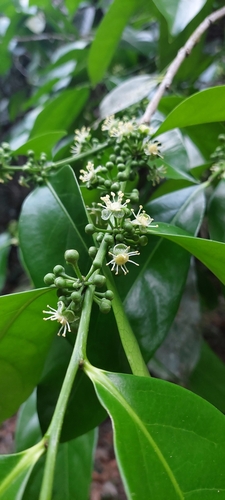
Drypetes kikir
Airy Shaw
PutranjivaceaeFruit

gbif · cc0
President and Fellows of Harvard College
President and Fellows of Harvard College

gbif · cc0
President and Fellows of Harvard College
President and Fellows of Harvard College

gbif · cc0
President and Fellows of Harvard College
President and Fellows of Harvard College
What to Eat
Edible parts: Fruit
The fruit is eaten.
Where to Find It
It is a tropical plant. It grows in the rain forest up to 1,500 m above sea level. It is usually on sandy soils.
Asia, Indonesia, Malaysia, SE Asia,
Countries: United Arab Emirates, Afghanistan, Armenia, Azerbaijan, Bangladesh, Bahrain, Brunei, Bhutan, China, Georgia, Indonesia, Israel, India, Iraq, Iran, Jordan, Japan, Kyrgyzstan, Cambodia, North Korea, South Korea, Kuwait, Kazakhstan, Laos, Lebanon, Sri Lanka, Myanmar, Mongolia, Maldives, Malaysia, Nepal, Oman, Philippines, Pakistan, Qatar, Saudi Arabia, Singapore, Syria, Thailand, Tajikistan, Timor-Leste, Turkmenistan, Turkey, Taiwan, Uzbekistan, Vietnam, Yemen
How to Identify
A tree. It grows about 36 m high. The leaves are alternate and simple They are leathery. The flowers are 3 mm across. They are greenish-yellow. They are in groups in the axils of leaves. The fruit are 1.5 cm long and orange and fleshy.
How to Grow
A dioecious species, both male and female forms need to be grown if fruit and seed are required.
Names & Synonyms
Gambe, Katong-katong, Kayu kikir, Kikir, Nyalin
References (1)
- Slik, F., www.asianplant.net