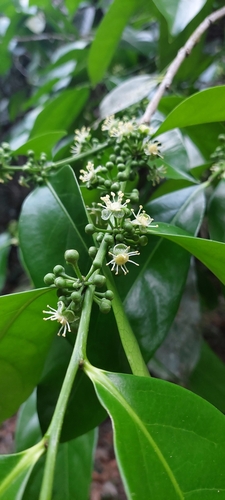
Drypetes longifolia
(Blume) Pax & Hoffm.
Long-leaf drypetes tree

(c) filibot.web, some rights reserved (CC BY-NC-SA)

Wikimedia Commons - R.Rahasia

Wikimedia Commons - R.Rahasia
What to Eat
Edible parts: Fruit
The fruit is edible.
Known Hazards
Where to Find It
It is a tropical plant. It grows in forests up to about 600 m above sea level. It grows on sandy soils along rivers and on dry hillsides. It can be on limestone.
Andaman Islands, Asia, Brunei, India, Indochina, Indonesia, Malaysia, New Guinea, Philippines, SE Asia, Thailand
How to Identify
A tree. It grows about 30 m tall. The twigs are hollow and filled with ants. The leaves are alternate and simple. The base of the leaf is unequal. The leaves are large. The flowers are 8 mm across and white. They are in groups in the axils of leaves. They fruit are about 2.5 cm long. They are orange red and fleshy. They are on the stems. The plant is defended by ants.
How to Grow
Plants can be grown from seeds.
Names & Synonyms
Kikr daun besar, Maklawi, Mintulang, Pohon kikir daun panjang
References (2)
- Slik, F., www.asianplant.net
- Sukarya, D. G., (Ed.) 2013, 3,500 Plant Species of the Botanic Gardens of Indonesia. LIPI p 248