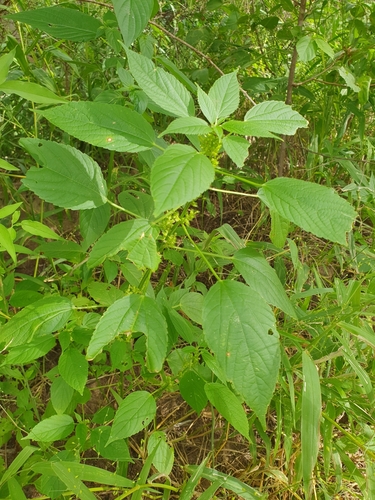
Ptychopyxis bacciformis
Croizat
EuphorbiaceaeFruit

gbif · cc0
President and Fellows of Harvard College
President and Fellows of Harvard College

gbif · cc0
President and Fellows of Harvard College
President and Fellows of Harvard College

gbif · cc0
President and Fellows of Harvard College
President and Fellows of Harvard College
What to Eat
Edible parts: Fruit
The fruit is eaten, particularly valued for the sweet fleshy aril surrounding the seeds.
Where to Find It
It is a tropical plant. It grows in mixed forest up to 500 m above sea level. It can be on sandy or clay soils.
Asia, Indonesia, Malaysia, SE Asia,
Countries: United Arab Emirates, Afghanistan, Armenia, Azerbaijan, Bangladesh, Bahrain, Brunei, Bhutan, China, Georgia, Indonesia, Israel, India, Iraq, Iran, Jordan, Japan, Kyrgyzstan, Cambodia, North Korea, South Korea, Kuwait, Kazakhstan, Laos, Lebanon, Sri Lanka, Myanmar, Mongolia, Maldives, Malaysia, Nepal, Oman, Philippines, Pakistan, Qatar, Saudi Arabia, Singapore, Syria, Thailand, Tajikistan, Timor-Leste, Turkmenistan, Turkey, Taiwan, Uzbekistan, Vietnam, Yemen
How to Identify
A tree. It grows 36 m high. The leaves are alternate and simple. They are hairy underneath. The flowers are 3.5 mm across. They are yellow and in branched groups. The fruit are 2 cm across. They are yellow and fleshy. The seeds have a sweet fleshy layer or aril around them.
Wikipedia
Source ↗Ptychopyxis bacciformis is a species of flowering plant in the family Euphorbiaceae, native to Vietnam to Sumatra and the Philippines. It was first described by Léon Croizat in 1942.
Names & Synonyms
Bantas
Ptychopyxis poilanei Croizat
References (2)
- Slik, F., www.asianplant.net
- Stoops, E. & van Welsen, P.C., 2013, A revision of Ptychopyxis (Euphorbiaceae) in southeast Asia. Nordic Journal of Botany 31: 094–112, 2013