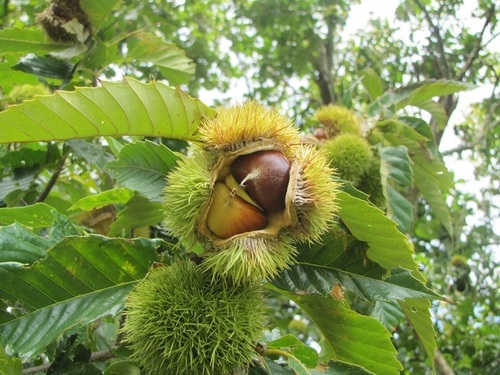
Castanea crenata
Siebold et Zuccarini
Japanese chestnut

(c) Marco Mussita, some rights reserved (CC BY), uploaded by Marco Mussita

(c) harum.koh, some rights reserved (CC BY-SA), uploaded by harum.koh
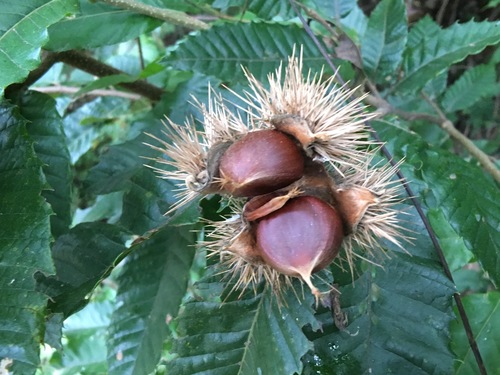
(c) Kim, Hyun-tae, some rights reserved (CC BY-NC), uploaded by Kim, Hyun-tae
What to Eat
Edible parts: Nuts, Seeds
The seeds can be eaten raw or cooked and serve as a potato substitute and a source of starch. Flavor is generally very poor — coarse and of little value — though quality varies considerably between individual plants. Any astringency can be removed by boiling the seeds in salted water.
Dangerous Lookalikes
This plant can be confused with the following toxic species. Always verify identification carefully before consuming any wild plant.


Horse Chestnut (Conker): Round smooth nuts (conkers), bumpy green husk (not very spiny), palmate compound leaves (like a hand).
Japanese chestnut: Nuts with pointed tassel, very spiny bur casing, simple toothed leaves.
Where to Find It
It is a temperate plant. It can tolerate wet and humid weather and hot summers up to 30°C. It needs night time winter temperatures of 0-4°C for flowers and fruit. In Hawaii this is above about 1300 m altitude. It is resistant to chestnut blight.
Asia, Australia, China, Cuba, Hawaii, Japan*, Korea, North America, Pacific, Taiwan, USA, West Indies,
How to Identify
It can be a small bush to a large tree. It can be 15 m tall. It often has several stems. The leaf blade is long and sword shaped. It is 8-19 cm long. There are hairs underneath. There are also yellow-brown scales underneath. The base is wedge shaped or rounded. There are fine teeth along the edge. The male flower is 7-20 cm long. There are 3 female flowers together. The cups are 5-6 cm across. They are covered with spine like bracts. These are 1-1.5 cm long. There are 2-3 nuts per cup. These are 2-3 cm across. There are fine hairs at the tip.
Nutrition Score: 65/100
| Part | Moisture | kJ | kcal | Protein | Vit A | Vit C | Iron | Zinc |
|---|---|---|---|---|---|---|---|---|
| Nuts - dried | 10 | 1506 | 360 | 5.3 | 9 | 61.3 | 3.4 | 2.3 |
| Nuts - raw | 61.4 | 644 | 154 | 2.25 | 4 | 26.3 | 1.45 | 1.1 |
How to Grow
Prefers a good well-drained slightly acid loam but succeeds in dry soils. Once established, it is very drought tolerant. Very tolerant of highly acid, infertile dry sands. Averse to calcareous soils but succeeds on harder limestones. The majority of species in this genus only really thrive in areas with hot summers, though this species is better adapted to British conditions than most. Cultivated for its edible seed in Japan, there are many named varieties. It is often also cultivated for its seed in America because it is fairly resistant to chestnut blight. Individual trees are very variable with regard to size of the seed, resistance to blight and astringency of the seed. Some cultivars have the largest seeds of any member of this genus. Trees fruit freely when only 3 - 3.5 metres tall. This species is occasionally planted as a timber tree in S. Europe. An excellent soil-enriching understorey in pine forests. Flowers are produced on wood of the current year's growth. Plants are fairly self-sterile. They hybridize freely with other members of this genus. Plants in this genus are notably resistant to honey fungus.
Propagation: Sow seed as soon as it is ripe, either in a cold frame or in an outdoor seedbed, and protect it from mice and squirrels. The seed has short viability and must not be allowed to dry out. It can be stored moist in a cool place such as the salad compartment of a fridge for a few months, but should be checked regularly for signs of germination. Germination typically occurs in late winter or early spring. Seedlings raised outdoors can be left in situ for one to two years before being moved to permanent positions. Plants grown in pots can go out to permanent positions in summer or autumn, with some cold protection in their first winter.
Medicinal Uses
None known.
Other Uses
The bark, leaves, wood, and seed husks all contain tannin. The wood is hard, strong, light, and very durable, and is used for furniture, construction, fence posts, and similar applications.
Wikipedia
Source ↗Castanea crenata, the Japanese chestnut or Korean chestnut, is a species of chestnut native to Japan and Korea. Castanea crenata exhibits resistance to Phytophthora cinnamomi, the fungal pathogen that causes ink disease in several Castanea species. The mechanism of resistance of Castanea crenata to Phytophthora cinnamomi may derive from its expression of the Cast_Gnk2-like gene.
Production
Seedling trees have borne nuts in 2 years.
Other Information
It is important throughout Japan. It is a cultivated food crop.
Notes
All Castanea bear edible nuts. There are about 12 Castanea species.
Names & Synonyms
Bamnamu, Castano del Japon, Kuri, Pamnamu, Ri ben li, Sanbamnamu, Yam, Yam-sey
References (28)
- Abh. Math.-Phys. Cl. Koenigl. Bayer. Akad. Wiss. 4(3):324. 1846
- Arora, R. K., 2014, Diversity in Underutilized Plant Species - An Asia-Pacific Perspective. Bioversity International. p 94, p 101
- Bodkin, F., 1991, Encyclopedia Botanica. Cornstalk publishing, p 224
- Chen, B. & Qiu, Z., Consumer's Attitudes towards Edible Wild Plants, Ishikawa Prefecture, Japan. p 22 www.hindawi.com/journals/ijfr/aip/872413.pdf
- Facciola, S., 1998, Cornucopia 2: a Source Book of Edible Plants. Kampong Publications, p 114
- FAO, 1995, Edible Nuts. Non Wood Forest Products 5.
- Huang Chengjiu, Zhang Yongtian, Bartholomew, B., Fagaceae, Flora of China.
- Gouldstone, S., 1983, Growing your own Food-bearing Plants in Australia. Macmillan p 139
- Hwang, H., et al, 2013, A Study on the Flora of 15 Islands in the Western Sea of Jeollanamdo Province, Korea. Journal of Asia-Pacific Biodiversity Vol. 6, No. 2 281-310
- Hwang, HS, et al, 2014, Distribution characteristics of plant in the Ungseokbong Mountain, Gyeongsangnam-do, Korea. Journal of Asia-Pacific Biodiversity. 7(2014) e164-e178
- Kim, H. & Song, M., 2013, Ethnobotanical analysis for traditional knowledge of wild edible plants in North Jeolla Province (Korea). Genetic. Resour. Crop Evol. (2013) 60:1571-1585 (As var. kusakuri)
- Lee, Y. M., 2014, Important Plants of East Asia II: Endemic Plant Stories. East Asia Biodiversity Conservation Network p 50
- Lyle, S., 2006, Discovering fruit and nuts. Land Links. p 115
- Miguel, E., et al, 1989, A checklist of the cultivated plants of Cuba. Kulturpflanze 37. 1989, 211-357
- Pemberton, R. W. & Lee, N. S., 1996, Wild Food Plants in South Korea: Market Presence, New Crops, and Exports to the United States. Economic Botany, Vol. 50, No. 1, pp. 57-70
- Plants for a Future database, The Field, Penpol, Lostwithiel, Cornwall, PL22 0NG, UK. http://www.scs.leeds.ac.uk/pfaf/
- Smith, P.M., 1979, Chestnut, in Simmonds, N.W., (ed), Crop Plant Evolution. Longmans. London. p 307
- Solomon, C., 2001, Encyclopedia of Asian Food. New Holland. p 75
- Song, M., et al, 2013, Traditional knowledge of wild edible plants in Jeju Island, Korea. Indian Journal of Traditional Knowledge. 12(2) pp 177-194 (Also as Castanea crenata var. kusakuri)
- Staples, G.W. and Herbst, D.R., 2005, A tropical Garden Flora. Bishop Museum Press, Honolulu, Hawaii. p 335
- Tozer, F., 2007, The Uses of Wild Plants. Green Man Publishing. p 59
- USDA, ARS, National Genetic Resources Program. Germplasm Resources Information Network - (GRIN). [Online Database] National Germplasm Resources Laboratory, Beltsville, Maryland. Available: www.ars-grin.gov/cgi-bin/npgs/html/econ.pl (10 April 2000)
- Wickens, G.E., 1995, Edible Nuts. FAO Non-wood forest products. FAO, Rome. p 21, 123
- Wiersema, J. H. & Leon, B., 2013, World Economic Plants. A Standard Reference CRC Press. 2nd Ed. p 151
- Williams, D., 2017, Ainu Ethnobiology. Contributions in Ethnobiology. Society of Ethnobiology. p 123
- Woo, Y., et al, 2017, Antioxidant Potential of Selected Korean Edible Plant Extracts. Hindawi BioMed Research International Volume 2017, Article ID 7695606
- World Checklist of Useful Plant Species 2020. Royal Botanic Gardens, Kew
- Zeven, A. C. & de West, J. M. J., 1982, Dictionary of cultivated plants and their regions of diversity. Wageningen. p 36
More from Fagaceae