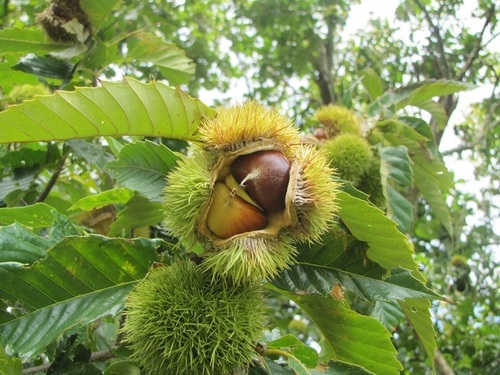
Castanea dentata
(Marshall) Borkh.
American chestnut, American sweet chestnut

(c) Bob MacInnes, some rights reserved (CC BY)

(c) BobMacInnes, some rights reserved (CC BY)

(c) Kent McFarland, some rights reserved (CC BY-NC)
What to Eat
Edible parts: Nuts, Seeds
The seeds are among the sweetest of any chestnut species, though on the small side, and can be eaten raw or cooked. They contain about 7% fat and 11% protein. Dried seeds can be ground into a flour and added to cereals for use in breads and cakes. A delicious oil can be extracted by crushing the nuts, boiling them in water, and skimming the oil from the surface — it works well as a topping for puddings. The roasted nut can serve as a coffee substitute, and a chocolate substitute can also be made from it.
Known Hazards
Dangerous Lookalikes
This plant can be confused with the following toxic species. Always verify identification carefully before consuming any wild plant.


Horse Chestnut (Conker): Round smooth nuts (conkers), bumpy green husk (not very spiny), palmate compound leaves (like a hand).
American chestnut: Nuts with pointed tassel, very spiny bur casing, simple toothed leaves.
Where to Find It
It is a temperate plant. It is native to eastern North America. It can grow on a variety of sites. It does best on well drained sands and gravels. It suits hardiness zones 4-9.
Australia, Canada, North America*, Taiwan, USA*,
How to Identify
A large tree. It grows up to 35 m high. The trunk can be 100 cm across. The tree loses its leaves during the year. The leaves are alternate and simple. They taper gradually to both ends. They are 15-28 cm long. The leaves are yellowish green. There are 15-20 parallel veins on each side of the leaf. These end in a tooth with a bristle. The flowers are separately male and female on the same tree. The male or pollen flowers are on short stalks in erect catkins. These are 12-20 cm long. They are in the axils of leaves. The female or seed flowers occur singly or in clusters or 2 or 3 at the base of some of the male flowers. The fruit is a nut. These occur in small clusters of 1-5 within a spiny husk. This is 5-8 cm across and splits into 4 parts. Each but is oval and flat on one side. It is pointed. The surface is brown and smooth. The nuts are edible.
How to Grow
Plants can be grown from seed. Seedlings need transplanting very early. It can also be grown by layering.
Propagation: Sow seed as soon as it is ripe, either in a cold frame or in an outdoor seedbed, and protect it from mice and squirrels. The seed has short viability and must not be allowed to dry out. It can be stored moist in a cool place such as the salad compartment of a fridge for a few months, but should be checked regularly for signs of germination. Germination typically occurs in late winter or early spring. Seedlings raised outdoors can be left in situ for one to two years before being moved to permanent positions. Plants grown in pots can go out to permanent positions in summer or autumn, with some cold protection in their first winter.
Medicinal Uses
A warm water infusion of the leaves has been used to calm the respiratory nerves and promote expectoration, and has also been used in treating whooping cough. Modern opinion, however, holds that the leaves act as no more than a mild astringent.
Other Uses
The bark is a good source of tannin, and the dried leaves contain 9% tannin. The wood and seed husks also contain tannin, with the husks containing 10–13%. A brown dye is obtained from the bark. The wood is soft, not particularly strong, light, very durable, and liable to warp; it weighs 28 lb per cubic foot. It splits easily and is used for cheap furniture, fence posts, and general construction.
Wikipedia
Source ↗A deciduous tree reaching 30m tall and 15m wide, hardy to UK zone 4. Flowers appear in July with seeds ripening in October. Monoecious and insect-pollinated. Tolerates light sandy, medium loamy, and heavy clay soils with good drainage; grows in nutritionally poor, mildly acid to very acid soils. Adapts to semi-shade or full sun, and handles both dry and moist conditions with drought tolerance.
Production
Production has been seriously affected by chestnut blight Endothia parasitica.
Notes
All Castanea bear edible nuts. There are about 12 Castanea species. It has been badly affected by chestnut blight (Cyphonectria parasitica).
References (25)
- Beckstrom-Sternberg, Stephen M., and James A. Duke. "The Foodplant Database." http://probe.nalusda.gov:8300/cgi-bin/browse/foodplantdb.(ACEDB version 4.0 - data version July 1994)
- Bianchini, F., Corbetta, F., and Pistoia, M., 1975, Fruits of the Earth. Cassell. p 190
- Bodkin, F., 1991, Encyclopedia Botanica. Cornstalk publishing, p 224
- Brickell, C. (Ed.), 1999, The Royal Horticultural Society A-Z Encyclopedia of Garden Plants. Convent Garden Books. p 235
- Coombes, A.J., 2000, Trees. Dorling Kindersley Handbooks. p 149
- Duke, J.A., 1992, Handbook of Edible Weeds. CRC Press. p 64
- Etherington, K., & Imwold, D., (Eds), 2001, Botanica's Trees & Shrubs. The illustrated A-Z of over 8500 trees and shrubs. Random House, Australia. p 188
- Facciola, S., 1998, Cornucopia 2: a Source Book of Edible Plants. Kampong Publications, p 114
- Farrar, J.L., 1995, Trees of the Northern United States and Canada. Iowa State University press/Ames p 270
- FAO, 1995, Edible Nuts. Non Wood Forest Products 5.
- Flowerdew, B., 2000, Complete Fruit Book. Kyle Cathie Ltd., London. p 200
- Hedrick, U.P., 1919, (Ed.), Sturtevant's edible plants of the world. p 174
- Kiple, K.F. & Ornelas, K.C., (eds), 2000, The Cambridge World History of Food. CUP p 1751
- Krochmal, A. & Krochmal, C., 1982, Uncultivated Nuts of The United States. United States Department of Agriculture Forest Service. p 9
- Little, E.L., 1980, National Audubon Society Field Guide to North American Trees. Alfred A. Knopf. p 377
- Lyle, S., 2006, Discovering fruit and nuts. Land Links. p 117
- MacKinnon, A., et al, 2009, Edible & Medicinal Plants of Canada. Lone Pine. p 60
- Menninger, E.A., 1977, Edible Nuts of the World. Horticultural Books. Florida p 13
- Plants for a Future database, The Field, Penpol, Lostwithiel, Cornwall, PL22 0NG, UK. http://www.scs.leeds.ac.uk/pfaf/
- Smith, P.M., 1979, Chestnut, in Simmonds, N.W., (ed), Crop Plant Evolution. Longmans. London. p 307
- Theor. prakt. Handb. Forstbot. 1:741. 1800
- Toupal, R. S. & Hollenback, K., 2009, An Ethnobotany of Indiana Dunes National Lakeshore: Plant Uses of the Ojibwa People. Bureau of Applied Research in Anthropology. University of Arizona
- Wickens, G.E., 1995, Edible Nuts. FAO Non-wood forest products. FAO, Rome. p 21, 123
- Wiersema, J. H. & Leon, B., 2013, World Economic Plants. A Standard Reference CRC Press. 2nd Ed. p 151
- World Checklist of Useful Plant Species 2020. Royal Botanic Gardens, Kew
More from Fagaceae