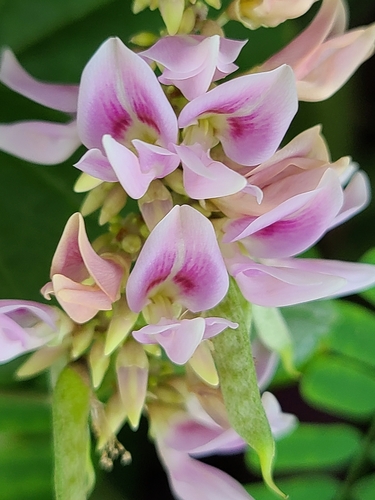
Dalea candida
Michx. ex Willd.
White prairie clover

(c) Alvin Diamond, some rights reserved (CC BY-NC), uploaded by Alvin Diamond
(c) cassi saari, some rights reserved (CC BY-NC), uploaded by cassi saari
(c) Esben Kjaer, some rights reserved (CC BY), uploaded by Esben Kjaer
What to Eat
Edible parts: Roots, Leaves - tea
The root can be eaten raw or chewed for its pleasant sweet flavour, and is enjoyed as a delicacy by children. A tea-like beverage is also made from the dried leaves.
Where to Find It
It is a temperate plant.
Mexico, North America, USA,
How to Identify
A perennial reaching 0.7 m tall by 0.5 m wide, hardy to UK zone 4. Flowers July to August. Hermaphroditic with bee and insect pollination; fixes nitrogen. Grows in light sandy and medium loamy well-drained soils, suits mildly acid to mildly alkaline pH. Requires full sun; tolerates dry or moist soil and drought.
How to Grow
Propagation: Pre-soak seed for 12 hours in warm water, then sow in early spring in a greenhouse. Prick seedlings into individual pots when large enough to handle and plant out into permanent positions in summer.
Medicinal Uses
The roots have been chewed to bring relief from toothache and similar pain.
Other Uses
No other uses are known for this plant.
Wikipedia
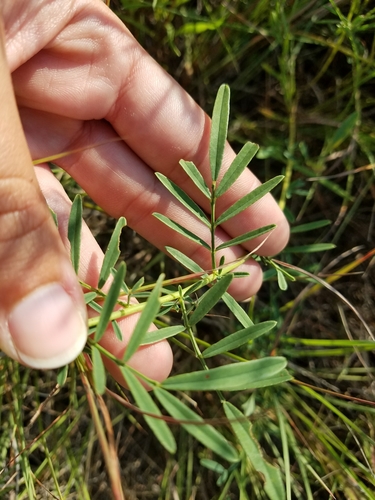
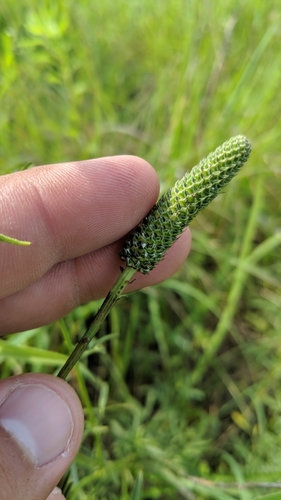
Source ↗Dalea candida is a species of flowering plant in the legume family known by the common name white prairie clover. It is native to North America, where it can be found throughout central Canada, the central United States, and northern Mexico. It can sometimes be found outside its range as an introduced species. It grows in many types of habitats, including several types of prairie, foothills, woods, forests, and disturbed areas. It is a perennial herb growing erect to a maximum height around 1 meter (3 ft 3 in), its taproot growing up to 5 or 6 feet (1.5 or 1.8 m) deep. The alternately arranged leaves are each composed of several narrow, gland-dotted, light green leaflets. The inflorescence is a dense cylindrical spike of flowers at the tip of each stem or stem branch. The spike is packed with the pointed green calyces of sepals, the lower ones bearing corollas of white petals and the higher ones blooming later. The fruit is a green oval legume pod containing one seed. A specimen of this species was collected by Meriwether Lewis in Nebraska in 1804.
Other Information
The root is chewed by children.
References (3)
- Kermath, B. M., et al, 2014, Food Plants in the Americas: A survey of the domesticated, cultivated and wild plants used for Human food in North, Central and South America and the Caribbean. On line draft. p 296
- Lim, T. K., 2015, Edible Medicinal and Non Medicinal Plants. Volume 9, Modified Stems, Roots, Bulbs. Springer p 32
- USDA plants